
Curated Cannabis Menu: What It Is and Why It Works
A curated cannabis menu is a short, deliberate list of products chosen for quality, batch consistency and variety, instead of a catalog of thousands of items. When your order arrives at the door and you can’t pick a jar off a shelf, that matters a lot. At Green On The Go, our menu is built around trusted California brands such as STIIIZY and Buddies, with lab results behind the products and same-day delivery across Alameda County. This guide explains how to read any cannabis menu, what to compare, and what a dependable one looks like.
TL;DR
- A curated menu is a filtered selection. The goal is fewer, better-vetted choices that you can compare quickly, not the biggest list.
- Every legal batch in California must pass state-required lab testing before sale, and the results appear on a Certificate of Analysis (COA).
- Compare product type, potency, batch information and label details, not just brand names and photos.
- Licensed edibles are capped at 10 mg THC per serving and 100 mg per package, which gives first-timers a clear starting frame.
- Our menu is curated around licensed, lab-tested products from brands we trust, delivered same day in Alameda County.
Table of Contents
- What a curated cannabis menu actually means
- Why curation matters more for delivery
- What to compare on any cannabis menu
- Lab results and the legal supply chain
- A note for first-time buyers
- How to tell a delivery menu is current and dependable
- Our curated menu, delivered same day
- Our perspective
- FAQ
- Sources
What a curated cannabis menu actually means
If you search for cannabis menus, the top results are mostly live store listings that show hundreds or thousands of products from 60 to 160 brands, each with a price and a THC percentage. That is a catalog. It is useful when you already know what you want and have time to scroll.
A curated menu is the opposite approach. Someone decides what earns a spot, and the rest is left off. Retail marketers describe curated formats as things like new arrivals, award winners, seasonal picks, staff picks, fan favorites and starter bundles, and they frame curation as guiding customers rather than limiting them. The point is that a shorter list is easier to compare, and each item on it has been chosen on purpose.
In practice, a good curated menu does four things:
- Covers the categories people actually buy. Flower, pre-rolls, vaporizers, concentrates, edibles and accessories, so you are not hunting across several sites.
- Keeps brands you can recognize. Familiar names mean you can repeat a good experience, which is how you find the products that suit you.
- Holds products to a consistent standard. Batch-to-batch consistency is what lets you reorder a favorite and get the same thing.
- Shows its proof. Licensed sourcing and lab results are available, not implied.
That last point is the dividing line between a menu that is merely short and one that is curated.
Why curation matters more for delivery
In a shop, you can ask a budtender, look at the packaging and pick things up. With delivery, the menu is the whole store. Everything you know about a product before it arrives comes from what the menu tells you.
That changes what you should want from it:
- Fast decisions. If you are a busy professional ordering between meetings, you want a menu where the top options are already good, not a 2,000-item scroll.
- Low risk of a bad fit. If you are new to cannabis, a smaller set of known brands and clearly labeled doses is easier to get right.
- Repeatability. If you already have a favorite, you want the next jar to match the last one.
Our menu is built for exactly this. We focus on a curated selection from trusted California brands, and our local drivers know Alameda County, so a short menu turns into a fast, discreet delivery. If you want to see where we deliver, our delivery areas page lists the cities we cover.
What to compare on any cannabis menu
Brand and price are the first things most people look at. Four other details tell you more.
Product type and format
Flower, pre-rolls, vapes, concentrates and edibles act differently. Smoked or vaporized products take effect quickly, while edibles take longer and last longer. Choose the format that matches how you want your evening to go, then compare within it.
Strain classification
California labels commonly show a strain classification such as indica, sativa or hybrid, and the City of Los Angeles explains that these terms are generally used to predict the type of high. Treat them as a starting point. If you want to go deeper, our strain guide walks through individual strains, including a profile of Apple Fritter.
Potency
THC is shown as a percentage on flower and in milligrams on edibles. A higher number is not automatically better. The right potency is the one that fits your experience level and the setting you plan to use it in.
Terpenes
Terpenes are the aromatic compounds that give cannabis its smell and flavor. They show up on COAs, and they are a useful way to choose between two products at similar potency. Our terpene guide explains how to read them and how they relate to vaping temperature.
The label itself
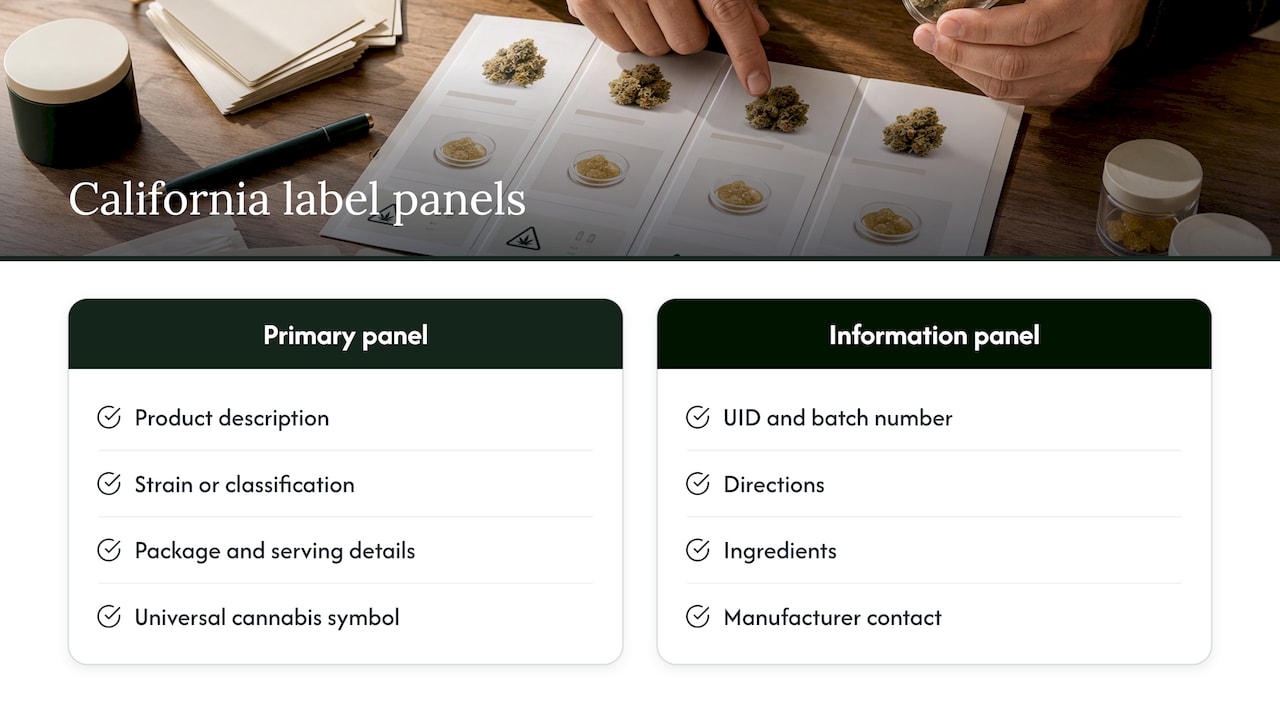
California labels follow a set format. The primary panel carries the product description, strain or classification, package and serving details, and the universal cannabis symbol. The information panel carries the unique identifier (UID) and batch number used for the state’s track-and-trace system, directions, ingredients, manufacturer contact and the government warning, as the City of Los Angeles label guide lays out. Our own guide to reading cannabis labels goes through a label panel by panel.
Lab results and the legal supply chain
This is where a curated menu earns its name. California’s Department of Cannabis Control (DCC) requires every batch of cannabis goods to be tested before sale. The DCC’s testing page lists what is checked: cannabinoids and terpenes, residual solvents, residual pesticides, heavy metals, microbial impurities, mycotoxins, moisture and water activity, and foreign material. Results are reported on a Certificate of Analysis that states pass or fail for each substance.
Two more details from the same page show how the system is built:
- Testing labs must hold ISO/IEC 17025 accreditation, follow standard operating procedures, run a quality assurance program and take part in proficiency testing.
- Labs upload each COA to the state’s track-and-trace system and send a copy to the DCC within one day of finishing a batch’s testing.
A COA is a long document, but you only need a few parts of it. Look for the batch number that matches your package, the cannabinoid totals that match the label, and pass results for pesticides, heavy metals, microbials and residual solvents. If you want to practice, how to verify cannabis lab reports covers a set of checks that apply to any lab report, and our own COA explainer and pesticide testing guide are written for California products.
Why batch consistency is the quiet benefit
Because each batch is tested and tracked, a product you liked can be matched to the batch it came from. A menu that sticks with a small set of established brands makes it far more likely that the next order lines up with the last. That is the practical value of curation: consistency you can plan around.
Licensed versus unlicensed
The DCC’s “What’s legal” page states that cannabis is legal in California for adults 21 and over, and for people 18 and over with a physician’s recommendation for medicinal use. It also notes that cities and counties may have stricter laws, and that unlicensed sellers may sell untested products that can contain mold, harmful chemicals, pesticides or mycotoxins. Licensed retailers display their state license with a scannable QR code.
The rules apply locally too. In unincorporated Alameda County, anyone delivering cannabis must hold a Cannabis Delivery Operator Permit under Chapter 6.108 of the county’s General Ordinance Code, according to the county planning page. Everything we sell comes through a legal supply chain with verifiable lab results.
A note for first-time buyers
If this is your first order, a curated menu does a lot of the work for you. The most useful rule of thumb is the edible limit. Licensed California edibles are capped at 10 mg of THC per serving and 100 mg per package, and labels must show the universal symbol, a bold government warning, and THC in milligrams per serving and per package, according to the Cannabis Health & Safety Alliance checklist. A much higher-dose edible can signal that it did not come from the licensed market.
A few practical habits help:
- Start with one serving, not a whole package, and wait before taking more, because edibles take longer to take effect.
- Pick one product type for your first order rather than trying several at once.
- Have your ID ready. You must be 21 or older, and our guide to delivery ID requirements lists what to have on hand.
- Know your limits on carrying cannabis. Our possession limits guide covers how much you can have with you.
If you have a medical condition or take prescription medication, talk with your doctor before using cannabis.
How to tell a delivery menu is current and dependable
A menu is only useful if what it shows is what you can actually get. These are the signs of a dependable one:
| What to look for | Why it matters |
|---|---|
| A state license with a scannable QR code | Licensed retailers must display it, and it ties the seller to the state’s records |
| Clear product type, potency and serving size | You can compare without guessing |
| Recognizable brands with batch information | Lets you match a product to its lab results |
| Child-resistant, tamper-evident packaging | Required for licensed products and a basic safety check |
| No hemp-derived THC vapes, flower or pre-rolls | Since January 1, 2026, California bans selling hemp vapes and other inhalable hemp products with THC, hemp flower and pre-rolls, synthetic-cannabinoid products and alcoholic drinks with cannabinoids (AB 8, 2025), per the CHSA checklist |
| Clear delivery area and timing | You know up front whether your address is covered and how soon it arrives |
The same checklist also tells you to confirm the license shows as Active and to check ID, which matches how licensed delivery works in California. Two practical points for the delivery itself: if you need to change where an order goes, our guide to changing a delivery address explains the steps, and if you are weighing options, delivery versus pickup lays out how the two compare. If you are ordering to a work address, see our guide on workplace weed delivery.
Our curated menu, delivered same day
We built our menu for people who want quality without the scroll. It covers flower, pre-rolls, vaporizers, concentrates, edibles and accessories from trusted California brands, including STIIIZY and Buddies, with licensed sourcing and verifiable lab results. Local drivers who know Alameda County bring your order to your door, from Oakland and Berkeley to Dublin and Fremont, with same-day delivery.
When you are ready, you can order same-day delivery online. If you live in Berkeley or Dublin, see the pages for Berkeley delivery and Dublin delivery.
Our perspective
Most people don’t need more choices. They need the right few, with proof behind them. When we build our menu, we start from what an East Bay customer is trying to do: get something reliable, quickly and discreetly, without wondering what’s in it.
That’s why we lean on brands like STIIIZY and Buddies, and why batch consistency matters to us as much as the product itself. A customer who finds a flower or a vape they like should be able to reorder it and get the same experience. A short, licensed, lab-tested menu makes that possible.
Delivery makes this even more important, because you can’t walk the aisle. Our drivers know Alameda County, so what you choose on the menu reaches you fast. We think that is what a curated menu is for: fewer decisions, better ones.
Jake
FAQ
What is a curated cannabis menu?
It is a deliberately selected list of products, chosen for quality, brand reliability and batch consistency instead of sheer volume. It makes comparing options faster, especially when you are ordering for delivery and can’t see the shelf.
Is a smaller menu a sign of fewer options?
It is a sign of a more focused selection. Our menu still spans flower, pre-rolls, vaporizers, concentrates, edibles and accessories, so you can find the format you want without wading through thousands of listings.
How do I know a product was lab tested?
In California, every batch must be tested before sale, and the results are reported on a COA with pass or fail for each substance, according to the DCC. Match the batch number on your package to the COA, and see our COA guide for what to read.
What should a first-time customer order?
Choose one product type and a low dose. Licensed edibles are capped at 10 mg THC per serving, so a single serving is a sensible start. Wait before taking more, and talk with your doctor first if you take medication or have a health condition.
Do you deliver across Alameda County?
Yes. We offer same-day delivery across the cities of Alameda County, and our delivery areas page lists them.
Sources
- Curated Dispensary Menus (ESBE Marketing)
- Reading a California Product Label (City of Los Angeles Cannabis Regulation)
- Testing laboratories (California Department of Cannabis Control)
- What’s legal (California Department of Cannabis Control)
- Commercial Cannabis Regulation in Unincorporated Alameda County
- Before you buy: questions to ask about a store or product (Cannabis Health & Safety Alliance)
- Hemp Lab Reports: 6 Checks for Small Buyers
Recommended
Ready to order?
Licensed, same-day cannabis delivery across Oakland, Berkeley, Fremont and all of Alameda County.
Order Online