
Batch Consistency in Cannabis: What It Means and How to Check It
Batch consistency means the product you buy this month behaves like the one you liked last month: the same potency, the same aroma, the same effect. Cannabis is a plant, so that sameness has to be built through sourcing, lab testing and a tight menu. At Green On The Go we deliver licensed, lab-tested products from trusted California brands such as STIIIZY and Buddies across Alameda County, and we curate the menu around batch quality. Below is what consistency actually covers, why batches drift, and how to read a lab report so you can judge any order yourself.
TL;DR
- Consistency means each gram or each serving carries the same cannabinoid content as the last. Homogeneity means one product, like a gummy pack, is even from piece to piece.
- Batches vary because cannabis is an agricultural crop. Harvest timing, light, curing, extraction and storage all move the numbers.
- A certificate of analysis (COA) is the lab report for one batch. Match its batch or lot number to your package before you trust it.
- No lab report guarantees every gram is identical, but a licensed supply chain with batch-level testing is the best protection you have.
- In Alameda County, we deliver same-day from a curated menu built around batch quality.
Table of Contents
- What batch consistency means
- Why the same product varies from batch to batch
- What California rules put around your dose
- What a lab report can and cannot tell you
- How to compare two batches in five steps
- Signs of a well-run, consistent product
- Our view on consistency
- Order from a menu built around batch quality
- FAQ
- Sources
What batch consistency means
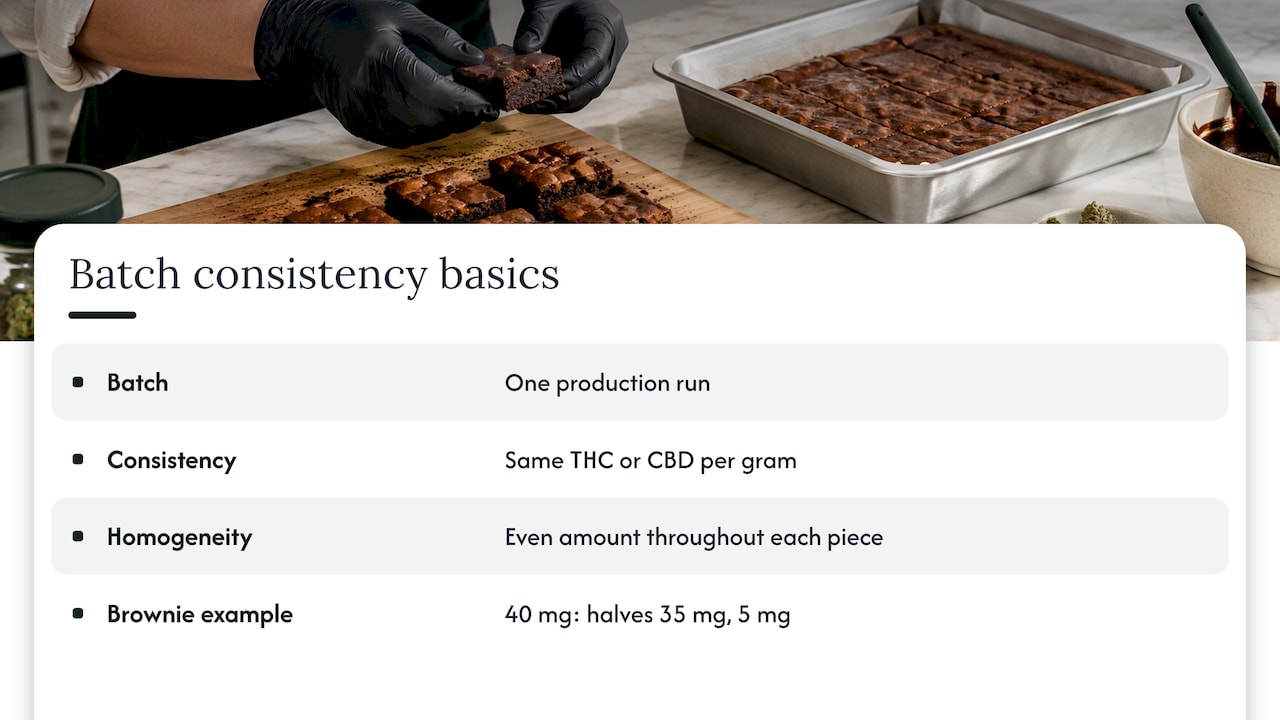
A batch is one production run: a harvest lot of flower, one extraction run of oil, one cook of gummies. Consistency is how closely that run matches the runs before it.
Cannabis Business Times splits the idea in two. Consistency means every gram of flower or oil holds as much THC or CBD as the gram before it. Homogeneity means every piece of an infused product, such as a chocolate bar, holds an even amount throughout. Together they let you take the dose you intend and get the same experience each time.
The same source gives a clear picture of why the second part matters: a 40 mg brownie that is not homogenous could deliver 35 mg in one half and 5 mg in the other. For a first-time user, that gap is the difference between a pleasant evening and a rough one.
Why the same product varies from batch to batch
Cannabis is not a manufactured chemical. A lab that tests potency explains that every batch of the same strain can differ in THC, terpenes and flavonoids. Harvest timing is one cause: flower cut too early has less THC, and flower left too long sees THC break down. Buds under the canopy get less light and test lower than sun-exposed buds from the same plant.
A 2026 review in the Journal of Cannabis Research traced the chain from crop to shop. Cultivar, growing environment, plant development stage, particle size, extraction choices and storage conditions such as temperature and light all shift the cannabinoid and terpene profile in predictable ways. In plain terms: consistency is decided at every step, not just at the grow.
Flower versus concentrates and edibles
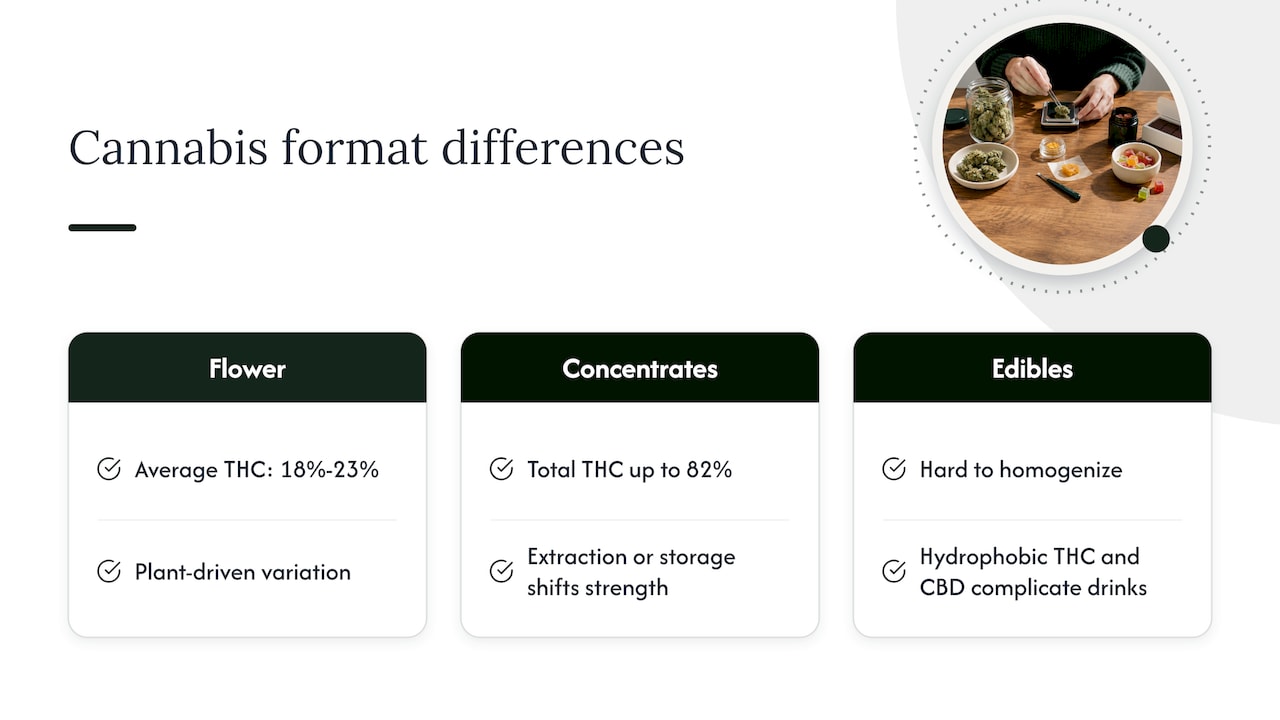
Flower varies with the plant. A study of more than 34,000 regulated Michigan products found average total THC of 18% to 23% in flower and up to 82% in concentrates. That wide range is why potency alone says little about whether two batches will feel alike. Concentrates start from a higher number, so small differences in the extraction run or storage can mean a noticeable difference in strength per puff or dab.
Infused products have their own challenge. A lab scientist writing in Lab Manager notes that THC and CBD molecules are hydrophobic, which makes drinks hard to infuse, and that gummies are hard to homogenize within and across batches. This is why edible makers invest in process control, and why the batch label matters more on edibles than anywhere else.
For a deeper look at choosing between the two formats, see our guide to choosing concentrates or flower safely.
What California rules put around your dose
California’s cannabis regulations cap edibles at 10 mg of THC per serving and 100 mg per package, and require that a single serving be easy to identify or measure. The state’s cannabis regulator also advises new users to start with lower-potency products, such as flower under 20% THC or edibles near 5 mg per serving, or to wait between doses so the effects have time to arrive.
Those caps keep an uneven piece from becoming a very large dose. They do not replace your own pacing. If you are new, start low, wait, and read our note on dosing with a low tolerance.
What a lab report can and cannot tell you
A certificate of analysis is a lab test report on a product’s safety, quality and potency. New Jersey’s Cannabis Regulatory Commission explains that products must be tested by a licensed third-party lab before sale, and that the report’s product section carries the strain or product name, a unique batch or lot number for traceability, the sampling date, and the lab’s name and license number. California labs work under California rules, but the structure of a COA is much the same.
Testing has honest limits that a careful buyer should know:
- A COA describes a sample. Labs test a representative portion of the batch. Oregon, for example, requires a representative sample of at least 0.5% of total batch weight for flower.
- Methods differ. The same source reports that no standard cannabinoid methods exist across the U.S., which causes lab-to-lab differences.
- Regulators allow a tolerance. Maryland, for one, accepts a potency variance of plus or minus 10% because of natural plant and infused-product heterogeneity, and requires edible content-uniformity testing on 10 random samples.
- Edible uniformity is hard everywhere. Food-safety guidance from the National Environmental Health Association notes that producers find even distribution through an edible difficult, and that states set different homogeneity limits.
The takeaway is practical. A 21.4% on one report and 20.1% on the next does not mean something went wrong. A large swing, a missing lot number or a missing lab name does.
How to compare two batches in five steps
- Find the batch or lot number on the package. It is usually printed near the license information or the sticker with the date.
- Open the COA by the QR code or batch listing. A research framework from clinicians recommends a certificate of analysis from a third-party lab as best practice, often reached through the company website or a QR code.
- Match the identifiers. The lot number, product name, product type and lab name on the report should match your package. A report for a different lot says nothing about yours.
- Compare total THC, not just the THC percentage. Flower holds most of its THC as THCA, which converts when heated. Our explainer on the total THC 0.877 rule shows the math: THC plus 0.877 times THCA.
- Check safety panels. Pesticides, microbes and heavy metals should all be tested. Our guide to pesticide testing in California shows how to read that section.
If you want a line-by-line walkthrough, we wrote one on reading your COA, and a second on reading cannabis labels in California.
A worked example
Say you bought a one-gram pre-roll last month and the COA showed total THC around 24%. This month the same brand and strain name arrives with a different lot number. Pull up the new COA. If total THC is 22% to 26%, the terpene profile lists similar leading terpenes, and the safety panels pass, you are looking at a consistent product. If total THC reads 14%, or the report lists a lot number that does not match, treat it as a different product and dose accordingly.
Signs of a well-run, consistent product
A CBD-industry evaluation framework from CBD Oracle describes the qualities worth looking for: full-panel testing by an accredited lab, a test for each batch, and consistent results across batches, which points to a reliable manufacturing process. That is written about hemp-derived products, but the logic carries over to licensed cannabis.
In practice, look for:
- A lot number and a test date on every package.
- A lab name and license number on the report.
- Results that stay within a similar range from one batch of the same product to the next.
- Clear units (percent for flower and vapes, milligrams for edibles).
- Brands that keep the same recipe, cure and extraction method over time.
Our view on consistency
We built Green On The Go around one idea: you should not have to gamble on what arrives at your door. That is why our menu is curated rather than endless. We carry trusted California brands like STIIIZY and Buddies because the point is batch consistency and quality, not the longest list.
Everything we sell comes through a legal supply chain, with verifiable lab results behind it. For us, that means a lab report you can read and match to your package, not a promise.
Our drivers are local and know Alameda County, so a product you pick for its consistency reaches you quickly and discreetly. If you are a busy professional, a longtime enthusiast who wants the same experience each time, or someone trying cannabis for the first time, a tight menu and a readable COA make the choice easier.
Consistency is not a single test. It is sourcing, curation, and paying attention to the batch in front of you.
Jake
Order from a menu built around batch quality
We deliver flower, pre-rolls, vaporizers, concentrates, edibles and accessories, same-day, to every city in Alameda County, including Berkeley and Dublin. Everything is licensed and lab-tested. You must be 21 or older. Browse the menu and place a same-day order, or check the full list of delivery areas.

If you are choosing by effect, our strain guide and blog and the explainer on THC versus CBD are good places to start.
FAQ
Is batch-to-batch variation normal in cannabis?
Yes. Cannabis is a plant, so growing conditions, harvest timing and curing all change the final numbers. Small differences in potency between batches are expected, and regulators in some states build in a tolerance for exactly that reason. What you want is a narrow range, not an identical number.
How do I know a COA matches my product?
Compare the batch or lot number, product name and lab name on the report with your package. If they match, the report describes your batch. If the lot number differs, you are reading a report for something else.
Why do edibles feel less predictable than flower?
Spreading THC evenly through a gummy or chocolate is hard, because THC does not mix easily with water-based ingredients. California limits edibles to 10 mg per serving and 100 mg per package, which caps the dose of any single piece. New users should start with about 5 mg and wait before taking more.
Does a higher THC percentage mean a better batch?
No. Percentage tells you strength, not quality or consistency. A better test is whether total THC, terpenes and safety results stay in a similar range from batch to batch, and whether the lot number on the report matches your package.
Sources
- The Importance of Random Hemp and Cannabis Sampling, Cannabis Business Times
- How Accurate are THC Potency Tests?, ACS Laboratory
- Cannabis: from crop to shop, Journal of Cannabis Research
- Potency levels of regulated cannabis products in Michigan, Journal of Forensic Sciences
- THC Testing in Cannabis and Hemp, Lab Manager
- Department of Cannabis Control audit, California State Auditor
- Cannabis Testing Guidelines and How to Read a Certificate of Analysis, New Jersey Cannabis Regulatory Commission
- Authority for Cannabis Testing, Maryland Cannabis Administration
- NEHA Food Safety Guidance for Cannabis-Infused Products
- A Clinical Framework for Evaluating Cannabis Product Quality, PMC
- A Comprehensive Framework for Evaluating Cannabinoid Products, CBD Oracle
Recommended
Ready to order?
Licensed, same-day cannabis delivery across Oakland, Berkeley, Fremont and all of Alameda County.
Order Online