
Why THC Percentage Misleads: The Total THC 0.877 Rule
THC percentage measures how much THC exists by dry weight, so a gram of flower labeled 20% THC contains roughly 200 mg of THC. That number is a real, useful measurement, but it’s an incomplete predictor of how strong a product will actually feel once you consume it. Terpenes, tolerance, and dose all shape the experience just as much.
TL;DR:
- Lab testing variability means THC percentages can differ by several points between labs, making batch-specific COAs essential for accurate info.
- Total THC calculation accounts for THCA conversion but only provides a theoretical maximum, not a guaranteed potency after consumption.
- Edibles, concentrates, and flower are measured in milligrams, percentages, and potency ranges that are not directly comparable across formats.
- Higher THC percentages do not automatically produce a stronger or more intense effect due to factors like the entourage effect and individual tolerance levels.
- Starting with a small dose, checking batch COAs, and considering terpene profiles yields a more reliable experience than focusing solely on THC percentage.
Table of Contents
- How Labs Measure THC: THCA vs. THC and the Total THC Formula
- Typical THC Ranges by Product Type (and How to Read Them)
- Why a Higher Percentage Doesn’t Guarantee a Stronger High
- How to Use THC Percentage When Shopping
- Lab Testing Variability and What a COA Actually Shows You
- How Green On The Go Helps You Buy With Confidence
- Why the THC Number Gets More Credit Than It Deserves
- Sources
How Labs Measure THC: THCA vs. THC and the Total THC Formula
Raw cannabis doesn’t contain much active THC at all. It’s loaded with THCA, an acidic precursor that converts to THC only when heated through a process called decarboxylation, which happens when you smoke, vape, or bake flower into an edible.
Because most flower on a shelf hasn’t been heated yet, labs report a calculated figure called Total THC instead of just THC. The formula is:
- Total THC = THC + (THCA × 0.877)
That 0.877 multiplier isn’t arbitrary. Converting THCA to THC strips away a carbon dioxide molecule, which reduces the compound’s total weight, and 0.877 corrects for that loss. The catch is that this number represents a theoretical ceiling, not a guarantee. Real-world conversion efficiency depends on how you consume the product. Total THC is a maximum, not a promise, since smoking, vaping, and baking all convert THCA to active THC at different rates.
Typical THC Ranges by Product Type (and How to Read Them)
THC numbers mean different things depending on what you’re holding. A 20% flower and a 20% concentrate are not comparable products, and neither converts to milligrams the same way.
Here’s roughly where things land across categories:
- Flower: typically 10% to 30% THC, with most quality strains landing in the high teens to low 20s.
- Concentrates: commonly 60% to 90% or higher THC, since extraction removes plant material and concentrates cannabinoids.
- Edibles: measured in milligrams per serving rather than percentage, usually 5 mg to 10 mg per piece for standard doses.
Average flower potency in regulated markets has climbed from around 5% in the 1990s to closer to 20% by 2025, which is part of why older assumptions about “strong weed” no longer apply. To turn a percentage into milligrams, multiply the decimal by 1,000: 20% THC equals about 200 mg per gram. Onset also matters as much as the number itself. Inhaled THC hits in minutes and fades in a couple of hours, while edibles take 30 minutes to 2 hours to kick in and can last 6 hours or more, so the same milligram amount feels completely different depending on how you take it.
Why a Higher Percentage Doesn’t Guarantee a Stronger High
This is where most shopping advice goes wrong. Higher THC on the label does not reliably mean a stronger subjective high, and there’s controlled research behind that claim.
A follow-up study comparing concentrates at around 70% versus 90% THC produced similarly flat results, which points to a plateau effect: past a certain THC threshold, more percentage stops translating into more high.
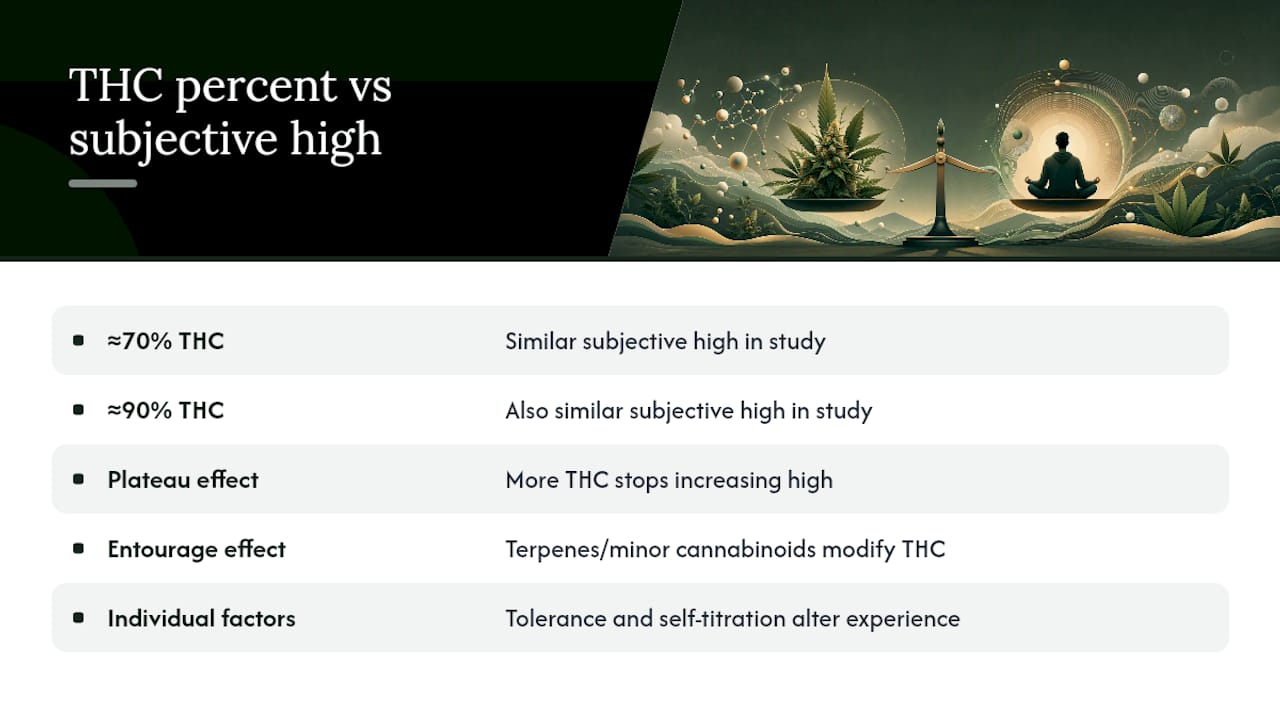
Part of the explanation is the entourage effect, the theory that terpenes and minor cannabinoids like CBD and CBN modify how THC behaves in the body. A moderate-THC strain with a rich terpene profile can feel more potent, or at least more distinct, than a high-THC strain with a thin one. Individual factors compound this further. Regular consumers build tolerance and need more THC to feel the same effect, while occasional users often self-titrate, unconsciously adjusting how much they inhale or how long they wait between edible doses based on how they feel.
Pro Tip: If two strains have similar THC percentages but wildly different terpene profiles, expect a different experience, not the same one. Smell is often a better first clue than the number on the label.
How to Use THC Percentage When Shopping
THC percentage is a starting filter, not a final answer. Use it alongside a few other checks before you commit to a purchase.
- Ask for the Certificate of Analysis (COA) on the specific batch, not just a generic strain average.
- Check the terpene panel if one is listed. A strain with a diverse profile often delivers a more balanced effect than a one-note high-THC product.
- Confirm batch number and test date. Cannabinoids degrade over time, so a COA from six months ago tells you less than a fresh one.
- Match starting dose to product type. For flower, take one to two hits and wait 10 to 15 minutes before deciding whether to continue. For edibles, start with 2.5 mg to 5 mg and wait a full 2 hours before taking more. For concentrates, treat any dab as a microdose until you know your tolerance.
- Skip alcohol and driving entirely when trying a new product, especially anything above 25% THC or a concentrate you haven’t used before.
Higher-THC products can make sense for experienced users managing chronic symptoms or seeking longer-lasting relief per dose, but they’re usually not the best starting point for someone new to a strain or format.
Pro Tip: Buy the smallest available size the first time you try a new batch. If the COA looks solid and the effect matches your expectations, you can size up next order.
Lab Testing Variability and What a COA Actually Shows You
Not all lab results are equally trustworthy, and this is the part most menus don’t advertise. The same cannabis sample tested at different labs can show potency results that differ by several percentage points, a gap large enough to matter when you’re comparing two products that claim similar strength. Some of that variance comes down to sampling method and equipment calibration. Some of it comes from “lab shopping,” where a brand quietly selects whichever lab returns the most favorable number.
A trustworthy COA gives you more than a THC figure. Look for:
- A full cannabinoid panel (THC, THCA, CBD, CBN, and minor compounds), not just one headline number.
- A terpene summary, which is often missing on cheaper or less transparent listings.
- Contaminant screens for pesticides, residual solvents, and heavy metals, which matter even more with concentrates since the extraction process can concentrate contaminants along with cannabinoids.
Treat a few patterns as warning signs: a menu where every single item tests above 30% THC, products listed with no COA at all, or batch numbers that don’t match what’s printed on the package. Any one of those should slow you down before you buy.
How Green On The Go Helps You Buy With Confidence
Many cannabis delivery services curate menus around trusted California brands and provide batch-level lab results to help customers understand what’s in their packages. Products typically move through legal supply chains with verifiable testing behind them, which matters more than the percentage printed on the label.
If you want to shop by more than THC alone, our strain guides break down terpene and cannabinoid context for individual strains, so you can match a product’s actual profile to what you’re looking for. When deciding between two options, customers are encouraged to ask for the batch COA before ordering and to start with a smaller quantity on anything new. It’s the fastest way to learn how a specific batch affects you before you commit to a larger purchase.
Why the THC Number Gets More Credit Than It Deserves
The obsession with THC percentage exists because it’s the easiest number to put on a shelf tag, not because it’s the most useful one. That’s the honest read on where the conventional wisdom goes wrong: dispensaries built a shopping habit around a single figure because it’s simple to compare, not because it correlates cleanly with how strong something feels.
The Colorado research on the plateau effect should have changed more shopping behavior than it has. What actually predicts a good experience is closer to boring: a fresh COA, a terpene profile that matches what you’re after, and a dose sized to your actual tolerance rather than your ego.
My honest priority order for anyone shopping today: COA first, terpenes second, THC percentage a distant third. The industry sells percentage because it fits on a label. Your experience depends on everything a label leaves out.
— Jake
This article is general information, not a substitute for advice from a qualified doctor. Consult a qualified healthcare professional about your own circumstances before acting on anything here.
Recommended
Ready to order?
Licensed, same-day cannabis delivery across Oakland, Berkeley, Fremont and all of Alameda County.
Order Online