
Patient Picks for Nausea: Lab Tested Strains and 1:1 THC:CBD Evidence
September 21, 2026
Patient Picks for Nausea: Lab Tested Strains and 1:1 THC:CBD Evidence
For most people, THC-forward or balanced 1:1 THC:CBD chemovars with limonene, beta-caryophyllene, or pinene provide the most reliable relief. Inhalation works fastest for a nausea wave that hits without warning, and clinical trials support that combination for tough, treatment-resistant nausea. Start low. Watch for dizziness or sedation, and talk to a clinician first if you’re managing chemotherapy or another serious condition.
TL;DR:
- Chemovars with high THC, balanced THC:CBD ratios, and specific terpenes like limonene, beta-caryophyllene, or pinene are most reliably effective for nausea relief.
- Inhalation provides the fastest onset within 1 to 10 minutes and is best for urgent relief during sudden nausea waves.
- Clinical trials show that a 1:1 THC:CBD extract improves complete nausea response from 8% to 24% in chemotherapy patients, with sedation and dizziness as common side effects.
- Dosing should start low, with inhalation doses held for 10 minutes and edibles with waiting periods up to 2 hours to avoid worsening symptoms.
- Avoid cannabis if pregnant, with unstable cardiac conditions, psychiatric issues, or on certain medications, and always consult a healthcare professional before use.
Table of Contents
- Best Strains for Nausea That Patients Actually Reach For
- How Cannabis Helps Nausea: The Science Behind the Relief
- How to Use Cannabis for Nausea: Methods, Timing, and Dosing
- Choosing by Terpenes and Ratios, Not Just Strain Names
- Risks, Side Effects, and When to Skip Cannabis for Nausea
- Why This Guide Leans on Both Patient Experience and Clinical Data
- Get Lab-Tested, Terpene-Labeled Strains Delivered Same Day
- Sources
- FAQ
Best Strains for Nausea That Patients Actually Reach For
Patients managing everything from chemo-related nausea to motion sickness tend to gravitate toward a specific handful of chemovars, and the pattern isn’t random. It tracks cannabinoid ratio and terpene content almost every time.
- Cannalope Kush — A THC-dominant hybrid with a strong pinene presence, often reported as clarifying rather than foggy, which matters if nausea comes with brain fog from medication. Check out the Cannalope Kush strain guide for its typical terpene profile.
- Wedding Cake — Balanced enough that many patients use it for both daytime queasiness and evening settling, thanks to a caryophyllene-heavy profile that leans into gut-related relief. The Wedding Cake strain guide breaks down its lab-tested terpene ranges.
- Clementine — A limonene-forward sativa that patients with anxiety-linked nausea reach for specifically because the citrus terpene tends to ease the mental churn that makes stomach symptoms worse. See the Clementine strain guide for details.
- Cherry Pie — An India-leaning hybrid with a heavier body effect, useful as a maintenance option in the evening when nausea and insomnia overlap.
- Cherry Zest — Combines citrus terpenes with a mellower cannabinoid load, a reasonable pick for people who want relief without heavy sedation. The Cherry Zest strain guide lists its cannabinoid ranges.
- Cherry — A straightforward, moderate-THC option some patients use as a baseline before trying something stronger.
- Chem Reserve — A potent, THC-heavy chemovar some experienced patients reserve specifically for breakthrough nausea when milder options haven’t worked.
- Animal Face — Reported by some users as effective for appetite return after nausea passes, which matters for chemo patients trying to rebuild caloric intake.
- Balanced 1:1 THC:CBD tinctures or capsules — Not a single strain but a category worth mentioning here because it mirrors the exact ratio used in the clinical trials discussed below.
None of these are guaranteed fixes, and individual response varies a lot based on tolerance, cause of nausea, and what else is going on medically.
Pro Tip: When you’re scanning a delivery menu, skip the marketing copy and go straight to the lab sheet. A product listing 1% beta-caryophyllene and 20% THC will behave very differently than one with the same THC number but heavy limonene. The terpene percentages tell you more about the actual experience than the strain name does.

How Cannabis Helps Nausea: The Science Behind the Relief
Nausea and vomiting get triggered through a brainstem structure called the dorsal vagal complex, where neurotransmitters like serotonin and substance P set off the vomiting reflex. CB1 receptors sit right in that pathway, and when THC activates them, it dampens the signal before it turns into an actual gag reflex. That’s the mechanistic basis researchers point to when explaining why cannabinoids work as antiemetics at all.
THC does most of the heavy lifting here. CBD doesn’t appear to drive the antiemetic effect on its own, but it may soften some of THC’s rougher edges, like anxiety or excessive sedation, which is why a lot of clinical formulations pair the two rather than using THC alone.
A phase II/III randomized, placebo-controlled trial testing an oral THC:CBD extract (2.5 mg of each, three times daily) found complete response, meaning no vomiting and no rescue medication needed, improved from 8% with placebo to 24% with the cannabinoid treatment, an absolute difference of 16 percentage points. Sedation and dizziness were both more common in the treatment group.
A separate randomized crossover trial in gynecologic cancer patients found the same 1:1 THC:CBD approach lowered mean nausea scores compared to placebo, again with sedation and dizziness showing up more often in the treated group. Both trials targeted refractory chemotherapy-induced nausea and vomiting (CINV), meaning nausea that didn’t respond well to standard antiemetic drugs. That’s an important distinction. Cannabinoids in current research aren’t positioned as a first-line replacement for guideline antiemetics. They’re studied as an add-on for cases where those first-line drugs already failed.
How to Use Cannabis for Nausea: Methods, Timing, and Dosing
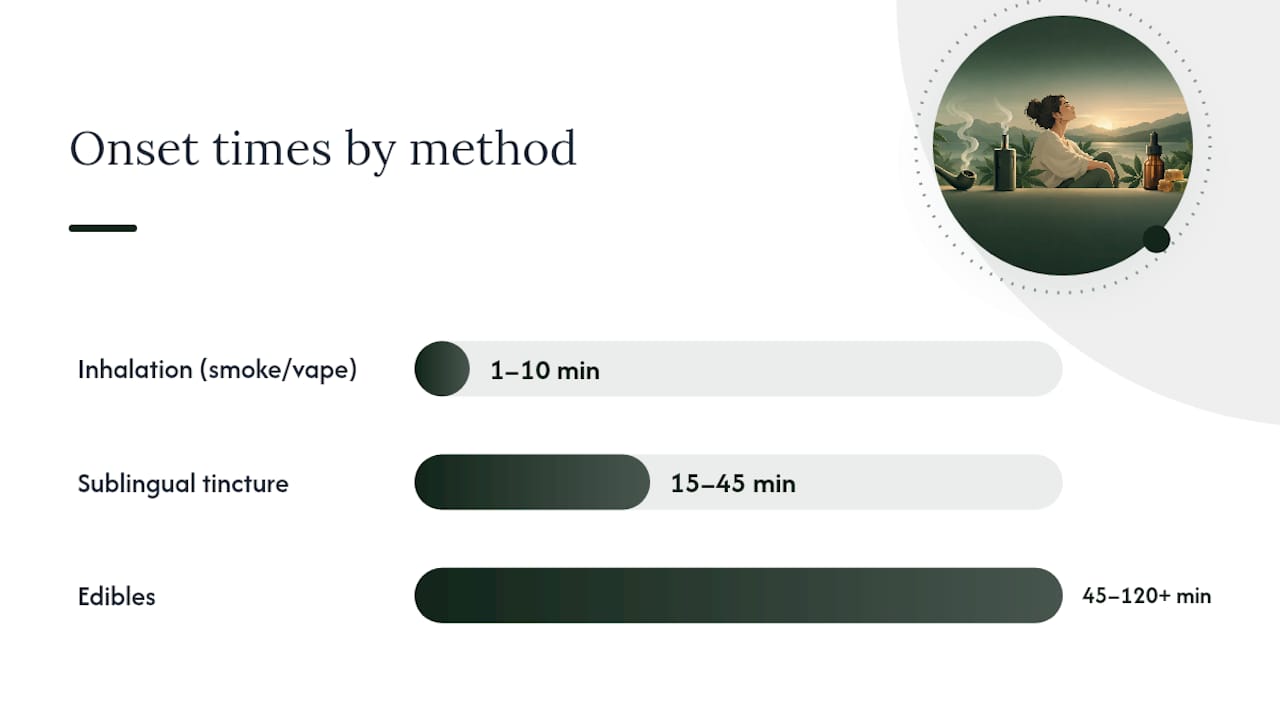
Picking the right method depends entirely on whether you’re dealing with a sudden wave of nausea or trying to prevent one before it starts. Here’s how the main methods stack up:
- Inhalation (smoking or vaping) — Onset in 1 to 10 minutes, effects lasting roughly 1 to 3 hours. Best for rescue situations where nausea has already hit and you need relief fast.
- Sublingual tinctures — Onset in 15 to 45 minutes, moderate duration. A good middle ground for people who want faster relief than an edible but don’t want to inhale anything.
- Edibles — Onset in 45 to 120 minutes or longer, with effects that can last 6 to 8 hours. Better suited to maintenance dosing than rescue use, since the delayed onset makes it easy to misjudge how much you actually need.
Titration matters more here than with almost any other symptom, because too much THC can flip from antiemetic to nausea-inducing in some people. A sensible approach: take one small inhaled dose and wait a full 10 minutes before taking more. With a tincture, dose low and wait 45 minutes before reassessing. With edibles, start at the lowest available dose and wait a full 2 hours before considering another.
If smoke irritation itself seems to worsen your nausea, a vaporizer or tincture avoids that trigger entirely. And if you’re managing chemotherapy or taking other medications, bring a current medication list to any clinician conversation. Cannabinoids can interact with drugs metabolized through the same liver pathways, and your oncology team needs the full picture.
Pro Tip: Log your dose, method, and how you felt afterward for at least a week. Patterns show up fast, and that log becomes genuinely useful if you ever need to explain your symptom management to a doctor.
Choosing by Terpenes and Ratios, Not Just Strain Names
Strain names are marketing labels. Terpene and cannabinoid percentages on a lab sheet are the actual data, and that’s what separates a useful choice from a guess.
Three terpenes come up again and again in patient reports and clinical discussion for nausea:
- Limonene — Associated with mood lift and reduced anxiety, useful when nausea is tangled up with stress or dread.
- Beta-caryophyllene — Interacts with CB2 receptors concentrated in gut tissue, making it a frequent pick for nausea with a digestive component.
- Pinene — Associated with mental clarity, helpful for people who want relief without the foggy feeling THC can sometimes bring.
These terpene associations come from clinical reasoning and patient consensus rather than dedicated randomized trials, so treat them as a smart selection tool, not a medical guarantee.
As a rule of thumb: for sudden, severe nausea, THC-forward inhalation tends to work fastest. For nausea tied to anxiety, a balanced 1:1 THC:CBD product is worth trying first. CBD-only products generally aren’t strong enough for severe nausea on their own, since THC is the cannabinoid doing most of the antiemetic work. When you’re browsing a menu, filter by terpene percentage and THC:CBD ratio before you filter by strain name.
Risks, Side Effects, and When to Skip Cannabis for Nausea
The same trials that show benefit also show a clear side-effect pattern worth knowing before you start.
- Sedation and dizziness were consistently more common in cannabinoid treatment groups across trial data, sometimes enough to affect daily function.
- Transient anxiety can show up, especially at higher THC doses or in people without much cannabis tolerance.
- Mitigation options include lowering the dose, switching to a more balanced THC:CBD ratio, or choosing a pinene-forward product for more clarity.
Certain groups should be more cautious or avoid cannabis for nausea altogether: pregnant people, anyone with unstable cardiac disease, people with a significant psychiatric history, and those on medications with known cannabinoid interactions. Regulatory guidance from Australia’s Therapeutic Goods Administration recommends that high-THC medicinal cannabis generally be reserved for cases where standard antiemetic treatments have already failed, reflecting how cautious the clinical community remains about treating it as a first choice.
Pro Tip: Never drive after dosing, and skip alcohol or other sedatives on days you’re using cannabis for nausea. The combination amplifies dizziness and sedation in ways that aren’t worth the risk.
Why This Guide Leans on Both Patient Experience and Clinical Data
Cannabis education deserves the same rigor as any health topic, which is why this guide pulls from randomized trial data alongside the patterns patients actually report. Readers looking for strain-specific detail can dig into the full strain guide library for terpene and cannabinoid breakdowns on individual chemovars.
Education is supported by information about licensed supply chains, lab results, and curated menus emphasizing consistency. Delivery by local drivers familiar with the service area helps facilitate access to specific terpene profiles without customer travel. None of this replaces a conversation with a clinician, especially for CINV or other medical nausea. This is educational content, not individualized medical advice.
— Jake
Get Lab-Tested, Terpene-Labeled Strains Delivered Same Day
This service offers product menus accompanied by lab results showing terpene and cannabinoid percentages, allowing customers to choose based on data rather than just strain names. Delivery options include same-day service to customers’ doors.

Start by browsing the strain education hub to compare terpene profiles for the chemovars mentioned above, checking lab results before you buy either way. If nausea is tied to chemotherapy, pregnancy, or a cardiac condition, loop in your doctor before starting anything new. When you’re ready to order, place a same-day delivery order and start with the lowest dose your chosen product allows.
FAQ
Which Strains Help With Nausea Most Reliably?
THC-forward or balanced 1:1 THC:CBD chemovars with limonene, beta-caryophyllene, or pinene tend to get the most consistent patient reports, including Cannalope Kush, Wedding Cake, and Clementine. Clinical trials support the 1:1 THC:CBD ratio specifically for refractory chemotherapy-induced nausea, where it improved complete response from 8% to 24%.
Is Sativa or Indica Better for Nausea?
Neither category reliably predicts nausea relief on its own, since cannabinoid ratio and terpene content matter more than the sativa/indica label. A limonene-heavy sativa might suit anxiety-linked nausea, while a caryophyllene-rich indica hybrid might suit nausea with a digestive component.
Why Does THC Help With Nausea?
THC activates CB1 receptors in the dorsal vagal complex, a brainstem region that regulates the vomiting reflex, which dampens the neurotransmitter signals that trigger nausea. CBD doesn’t appear to drive this effect directly but may reduce some of THC’s side effects when combined in a 1:1 ratio.
What Are Some Quick Ways to Stop Nausea With Cannabis?
Inhalation works fastest, with effects starting in 1 to 10 minutes, making it the go-to choice for a sudden nausea wave. Take one small dose, wait 10 minutes, and reassess before taking more, since overdoing THC can sometimes worsen nausea instead of easing it.
Does Green On The Go Sell Products Suited for Nausea Relief?
Green On The Go carries a curated, lab-tested menu that lists terpene and cannabinoid percentages for each product, which makes it possible to select chemovars matching the profiles discussed in this guide. Current prices and availability are listed on the order page.
Recommended
Ready to order?
Licensed, same-day cannabis delivery across Oakland, Berkeley, Fremont and all of Alameda County.
Order Online