
1–7.5 mg THC: Lab Tested Strains for Creativity That Protect Ideas
Jack Herer, Sour Diesel, Blue Dream, Durban Poison, Super Lemon Haze, and Green Crack top the list of strains people reach for when they need to think differently, not just get high. The approach that actually holds up: a low-to-moderate dose, a terpene profile leaning on pinene and limonene, and use limited to the ideation phase of a project. Push past that dose window and divergent thinking measurably drops, even in people who use cannabis regularly.
TL;DR:
- High doses of THC, especially around 22 mg, impair divergent thinking, while low doses of about 5.5 mg do not enhance performance in regular cannabis users.
- Terpene profiles, particularly pinene and limonene, influence effects more reliably than THC percentage, with pinene linked to alertness and memory support.
- Strain labels are unreliable; batch-specific lab reports of cannabinoids and terpenes provide better guidance for selecting products suited to creative tasks.
- Cannabis can create a subjective sense of increased creativity even when objective tests show no actual performance boost, due to psychological effects and altered brain networks.
- Using a microdose for brainstorming and switching to sober work for editing harnesses cannabis benefits while minimizing focus disruption.
Table of Contents
- Strains for Creativity That Artists and Writers Keep Coming Back To
- What the Research Actually Shows About Cannabis and Creative Thinking
- Terpenes and Chemistry: What to Prioritize for Focus
- How to Use Strains for Creativity Without Losing the Idea
- Why Lab-Tested Sourcing Solves the “Strain Name Means Nothing” Problem
- The Gap Between Strain Folklore and What Actually Helps
- Order Lab-Tested, Terpene-Profiled Strains for Your Next Creative Session
- Sources
Strains for Creativity That Artists and Writers Keep Coming Back To
Some strains earn their reputation for a reason, even if that reason has less to do with the strain name and more to do with what’s actually growing inside the batch. Here’s a rundown of the eight names that show up again and again in creative circles, along with what tends to make each one work.
-
Jack Herer. A sativa-leaning cross with a peppery, pine-forward terpene signature. The pinene content is often the draw here: it’s associated with mental clarity rather than the foggy drift some strains produce. Best used for early brainstorming, when you want ideas flowing without losing your train of thought.
-
Sour Diesel. Known for a sharp, fuel-like aroma driven by caryophyllene and limonene. Users report an energized, talkative headspace that suits collaborative brainstorming or writing sessions where you need to stay verbally sharp. THC can run high in some phenotypes, so check the lab sheet before assuming a light effect.
-
Blue Dream. A myrcene-and-pinene blend that splits the difference between relaxed and alert. It’s popular precisely because it doesn’t hit hard in either direction, which makes it forgiving for people newer to using cannabis for focused work. Better for light drafting than a first ideation sprint if the batch runs myrcene-heavy.
-
Durban Poison. A pure sativa landrace with a terpinolene profile that tends to read as uplifting and cerebral rather than sedating. This is often the pick for people who want energy without an anxious edge. Good for early-stage concept work, moodboarding, or anything that benefits from restless mental energy.
-
Super Lemon Haze. Citrus-forward thanks to a limonene-dominant profile, this one gets credited with mood elevation more than raw cognitive lift. Useful when creative blocks are more about mindset than mental fog. Potency varies widely by grower, so this is a strain where the batch matters more than the name.
-
Green Crack. Despite the name, this is a daytime strain built around alertness. Terpinolene and myrcene often show up together here, which means effects can swing toward energizing or toward couch lock depending on the specific harvest. Worth checking terpene percentages before committing to a session.
-
Tangerine Dream. A citrus-and-pine hybrid where limonene and pinene frequently co-dominate, a combination that shows up often in strains people describe as clarifying rather than heavy. Works well for light editing or refining ideas that already exist.
-
Acapulco Gold. A classic landrace sativa with a reputation for smooth, functional highs. Terpene data on this one is less consistently reported across labs, so treat anecdotal reports with more caution than lab-verified strains.
The names matter less than what’s inside the jar. Two batches labeled Jack Herer from different growers can have meaningfully different terpene and THC content, which is why checking the lab report before a creative session beats trusting the label alone.
What the Research Actually Shows About Cannabis and Creative Thinking
Creativity researchers split creative cognition into two modes: divergent thinking, which generates multiple novel ideas from a single starting point, and convergent thinking, which narrows options down to the single best solution. Cannabis appears to affect these two modes very differently, and that distinction is the single most useful thing to understand before choosing a strain or a dose.
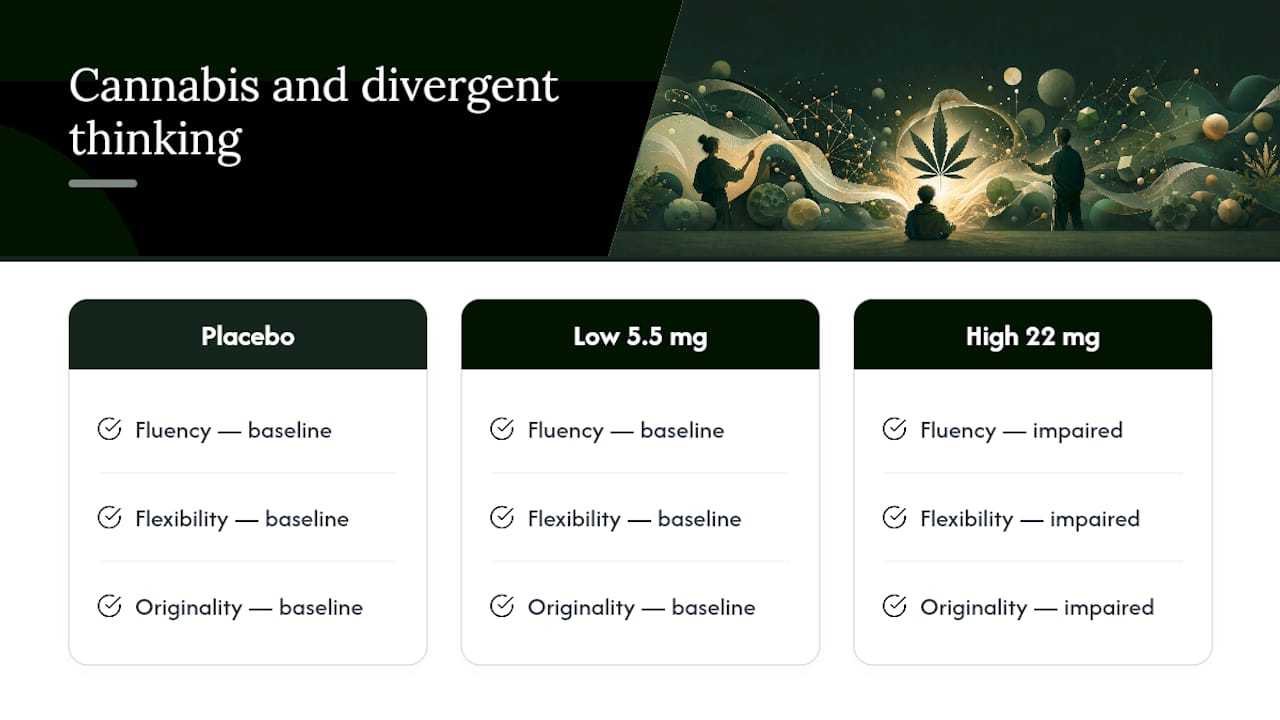
A randomized, double-blind study gave regular cannabis users either a placebo, a low dose (5.5 mg vaporized THC), or a high dose (22 mg). The high dose measurably impaired divergent thinking across fluency, flexibility, and originality. The low dose didn’t impair performance, but it also didn’t enhance it compared with placebo in that sample of experienced users. That’s an important nuance: low dose avoided the damage, it didn’t deliver a documented boost.
Harvard Business Review’s reporting on the broader literature adds a wrinkle that matches what a lot of creative users already suspect: people frequently feel more creative after using cannabis even when objective tests show no real gain, or a decline. That subjective versus objective gap comes down to a few factors, including dose, individual baseline creativity, and how self-criticism gets quieted during a session, a psychological effect distinct from any direct cognitive boost, as Psychology Today’s coverage of the research points out.
Neuroscience offers a plausible mechanism for the phase-specific pattern researchers keep finding. Functional-network reviews describe how THC can shift the balance between the brain’s default mode network, tied to divergent, associative thinking, and the executive control network, tied to convergent, task-focused thinking, a dynamic detailed in neuroscience-focused reporting on cannabis and creativity. That’s consistent with why cannabis might loosen associative thinking during brainstorming while making it harder to organize and execute those same ideas an hour later.
What the numbers add up to: high-dose THC (22 mg) impaired every measured aspect of divergent thinking in the PMC study, while low-dose THC (5.5 mg) matched placebo. The sample was made up of regular users, not first-time consumers, so results for occasional users could differ.
Terpenes and Chemistry: What to Prioritize for Focus
Terpenes shape effect far more reliably than THC percentage alone. A 20% THC flower with a myrcene-heavy profile can feel sedating, while a 16% THC flower dominated by pinene and limonene can feel clarifying and energized. That’s why terpene-based guides increasingly argue that batch-specific lab data matters more than strain reputation.
A handful of terpenes matter most for creative work:
- Pinene is linked to alertness, and some research suggests it may inhibit acetylcholinesterase, an enzyme that breaks down a neurotransmitter tied to memory. That mechanism could help offset some of the working-memory fog THC otherwise introduces.
- Limonene is associated with mood elevation and reduced anxiety, which matters for creative work because a calmer, more open headspace tends to support idea generation.
- Terpinolene shows up in strains described as cerebral and uplifting rather than heavy, often paired with the sativa-leaning strains on the shortlist above.
- Myrcene trends sedating and is common in strains marketed as relaxing. It’s usually the terpene to avoid if you need to stay sharp during a work session.
- Caryophyllene brings an anxiolytic, peppery quality that can smooth out a session without adding sedation, a useful supporting note rather than a primary driver.
Pro Tip: When you check a lab sheet, look past the THC percentage entirely and scan the terpene breakdown first. A profile where pinene and limonene rank in the top three terpenes is a stronger predictor of a clear, energized session than any THC number.
If a budtender or menu doesn’t list terpene percentages, ask directly. A shop that can’t answer probably hasn’t tested for it, which tells you something about how the product was sourced.
How to Use Strains for Creativity Without Losing the Idea
Dose and timing matter more than strain choice once you’ve picked something terpene-appropriate. Here’s a routine that keeps the upside of cannabis-assisted ideation without the downside of derailed focus.
- Start with a microdose. Roughly 1 to 2.5 mg of THC is enough to notice a subtle shift in associative thinking for most people, especially with a terpinolene or pinene-forward strain.
- Cap low-dose sessions around 2.5 to 7.5 mg inhaled-equivalent. This range matches what creative cannabis users commonly report as the sweet spot for ideation, and it stays below the threshold where the PMC study found divergent thinking impairment.
- Skip anything north of 10 mg if the task requires organization. Higher doses may loosen associative thinking further but tend to wreck the executive function needed to structure or finish an idea.
- Reserve cannabis for brainstorming, not editing. Go sober for the structural work: outlining, revising, arranging, finalizing. That split respects the same DMN/ECN trade-off the neuroscience points to.
- Build a capture system before you start. A voice memo app, a two-minute timer, or a dedicated notebook solves the single biggest complaint creative cannabis users report: good ideas disappearing the moment working memory resets.
Pro Tip: Set a phone timer for two minutes the moment an idea lands. Speak it into a voice memo before you second-guess it. Editing can wait until you’re sober; the idea can’t.
Watch for red flags that mean it’s time to dial back: persistent fog that outlasts the session, noticeable anxiety or panic, or heavy memory loss during ordinary conversation. Rotating strains and avoiding daily heavy use also helps prevent the tolerance creep that pushes people toward doses well past the range where any of this works.
Why Lab-Tested Sourcing Solves the “Strain Name Means Nothing” Problem
The research above only holds up if you actually know what’s in the product. A Jack Herer grown by one cultivator can taste and act nothing like a Jack Herer grown by another, which is why lab reports matter more than the label. Greenonthegodelivery sources its curated menu, including brands like STIIIZY and Buddies, through a fully licensed California supply chain, with verifiable lab results attached to each batch.
That matters for anyone trying to apply dose and terpene guidance in real life:
- Batch-specific THC and terpene data lets you actually check for pinene and limonene dominance instead of guessing from a strain name.
- Consistent sourcing from trusted brands reduces the batch-to-batch variation that makes strain reputations unreliable.
- Local drivers delivering across Alameda County, including Oakland and Berkeley, mean same-day access to tested product rather than a guessing game at an unfamiliar counter.
- The site’s strain education resources walk through terpene and cannabinoid content strain by strain, so you can check before you buy.
The Gap Between Strain Folklore and What Actually Helps
Most advice on strains for creativity treats strain names like brand loyalty: pick the right one and the magic happens. The research doesn’t support that. What it supports is dose discipline and terpene literacy, applied consistently, regardless of which name is on the jar. That’s a less exciting story, but it’s the one backed by actual dose-response data.
The biggest mistake I see in how people talk about this topic is treating “feeling creative” and “being more creative” as the same thing. They’re not. Cannabis reliably makes people feel looser and more associative, and that subjective shift is real and often useful. Whether it improves the actual output is a separate question, one the data answers with a firm “it depends on dose and it’s easy to overdo.”
If you take one thing from this, let it be the phase split: cannabis for generating raw material, sober focus for shaping it into something finished. Pair that with a habit of checking terpene panels instead of chasing strain reputations, and you’ll get more consistent results than any single “best strain” recommendation could promise. The capture system matters just as much as the dose. An idea you can’t remember an hour later never happened.
— Jake
Order Lab-Tested, Terpene-Profiled Strains for Your Next Creative Session
You can find terpene transparency by choosing products from a curated menu that provide lab results before ordering, allowing you to shop by pinene and limonene content instead of by strain name alone.

Same-day delivery covers cities across Alameda County, including Dublin, Berkeley, Albany, and Alameda, with knowledgeable local drivers who know the East Bay well enough to get tested product to your door fast. If you want to build a personal terpene shortlist before you order, the site’s strain education pages break down cannabinoid and terpene data strain by strain. When you’re ready to put the dosing and terpene guidance in this article into practice, check your delivery area and place an order for same-day drop-off.
This article is general information, not a substitute for advice from a qualified doctor. Consult a qualified healthcare professional about your own circumstances before acting on anything here.
Sources
- Cannabis and creativity: highly potent cannabis impairs divergent thinking in regular cannabis users
- Research: Does cannabis really make you more creative? | Harvard Business Review
- Cannabis for Energy, Focus, and Creativity: A Terpene-Based Guide
Recommended
Ready to order?
Licensed, same-day cannabis delivery across Oakland, Berkeley, Fremont and all of Alameda County.
Order Online