
30 Minute Seal Test: Smell Proof Cannabis Packaging Buyers' Checklist
September 12, 2026
30 Minute Seal Test: Smell Proof Cannabis Packaging Buyers’ Checklist
For most discreet transport and storage, high-barrier foil or Mylar pouches and activated-carbon lined hard cases reliably contain cannabis odor. Foil laminate pouches win for retail packaging and long-term storage; carbon-lined hard cases win for travel and daily carry. Glass jars with silicone gaskets hold their own for stash-at-home use over long periods. Whatever you buy, verify child-resistant compliance yourself. “Odor-proof” on a label means nothing without a laminate spec or test report behind it.
TL;DR:
- Foil laminate Mylar pouches provide the best odor blocking for retail and long-term storage due to their metallic barrier layers.
- Activated-carbon lined bags are ideal for daily carry and short-term use because they adsorb odors rather than block them.
- Hard-shell cases with rubber gaskets and locks are highly durable options for travel, offering crush protection and reusability.
- Verify laminate structure, seal integrity, and child-resistant testing before purchasing to ensure true odor proofing and compliance.
- Reusable containers like glass jars and hard cases are more environmentally friendly and can last several years with proper maintenance.
Table of Contents
- What Is the Best Smell Proof Packaging for Cannabis?
- How Do You Choose the Right Smell Proof Cannabis Storage?
- What Materials Actually Block Cannabis Odor?
- How Do You Test if Packaging Is Actually Smell Proof?
- How Long Does Smell Proof Packaging Last?
- Is Smell Proof Cannabis Packaging Bad for the Environment?
- What Makes Cannabis Packaging Design Stand Out on a Shelf?
- A Buyer’s Honest Take on Smell Proof Packaging
- A Simpler Alternative to Packing It Yourself
- Sources
- FAQ
What Is the Best Smell Proof Packaging for Cannabis?
Six product categories dominate this market, and they solve different problems. Knowing which one matches your actual use case (a weekend trip versus a wholesale shipment) saves you from buying the wrong thing twice.
Foil laminate Mylar pouches lead for retail and bulk storage because a continuous metallic layer blocks terpene migration almost completely. BoxBaba Cannabis Mylar Bags use a PET/ALU/PE laminate structure with a heat seal and optional child-resistant zipper, built specifically for compliance-driven retail runs. BOWE Cannabis Mylar Bags target the same space with foil-backed pouches sized for pre-rolls, flower, and edibles, and they are common in white-label brand kits.
Activated-carbon lined flexible bags work well for everyday carry when you need something soft and cheap. HerbGuard smell-proof bags use a carbon liner sewn into a nylon or canvas shell, good for a grinder and a few grams, less good for anything that needs to survive a suitcase. Herb Guard Smell Proof Bags & Cases extends the same lineup into zippered pouches and small cases, aimed at the casual consumer who wants one bag for the week.
Hard-shell cases add crush protection and a lock, which soft pouches can’t do. STASHLOGIX builds a hard-shell case lined with activated carbon fiber fabric, rubber gaskets, and water-resistant zippers, with replaceable carbon dividers that extend the case’s working life well past a single trip. DiscreetSmoker smell-proof stash box takes a similar approach: rubber lining plus a pressure valve that pushes toward a hermetic seal when the lid clicks shut, and it ships with a built-in lock for glove box or backpack storage.
FIREDOG Smell Proof Pouch/Backpack and OZCHIN Smell Proof Bag round out the travel category. FIREDOG’s line includes a full backpack with a carbon-lined main compartment, aimed at people who want odor control built into daily-use gear rather than a separate stash item. OZCHIN sticks to a simpler carbon-lined pouch with a combination lock, priced for consumers rather than brands.
| Product type / vendor | Barrier / liner | Best for | Closure | Child-resistant option | Durability | Price / MOQ |
|---|---|---|---|---|---|---|
| BoxBaba Mylar Bags | PET/ALU/PE foil laminate | Retail packaging, long-term storage | Heat seal, CR zipper option | Yes, available | Flexible pouch, single-use | Bulk pricing, brand MOQ required |
| BOWE Cannabis Mylar Bags | Foil-backed laminate | Retail packaging, brand kits | Zipper or heat seal | Available on some SKUs | Flexible pouch | Bulk/wholesale pricing |
| STASHLOGIX | Activated carbon fiber + rubber gasket | Travel, repeat use | Gasketed lock latch | Not a CR-certified closure | Hard-shell, reusable | Single-unit consumer pricing |
| DiscreetSmoker stash box | Rubber lining + pressure valve | Secure travel, concealment | Lockable lid | Not a CR-certified closure | Hard-shell, reusable | Single-unit consumer pricing |
| HerbGuard bags | Activated carbon liner | Daily carry, short-term storage | Zipper | No | Flexible pouch, reusable | Low-cost consumer pricing |
| Herb Guard Bags & Cases | Activated carbon liner | Daily carry, small case storage | Zipper, some cases add locks | No | Mixed flexible/hard | Low-to-mid consumer pricing |
| FIREDOG Pouch/Backpack | Carbon-lined compartment | Travel, daily-use gear | Zipper | No | Soft-shell, reusable | Mid consumer pricing |
| OZCHIN Smell Proof Bag | Activated carbon liner | Travel, budget storage | Zipper + combo lock | No | Flexible pouch, reusable | Low-cost consumer pricing |
A few checks separate a real barrier product from a bag with a scent-blocking label and nothing behind it:
- Ask whether the laminate includes a metallic layer (VMPET or foil, rather than plain PET or PE film.
- Check if the zipper is a heavy-gauge track, not a thin sandwich-bag style seal.
- Look for a published child-resistant test result if you’re buying for retail.
- Confirm the vendor will sell (or send) a sample before you commit to a production run.
How Do You Choose the Right Smell Proof Cannabis Storage?
Your decision comes down to five variables, and they matter in a different order depending on whether you’re a consumer or a business buyer.
- Barrier laminate structure. A PET/ALU/PE or VMPET laminate stops far more odor than a single-layer PE film, because it interrupts the permeation path terpenes use to migrate through weaker materials.
- Closure type. Heat seals outperform zippers for one-time retail packaging. Reusable zippers need a heavy gauge track, since a thin one stretches and leaks after a dozen open-close cycles.
- Filled headspace. Extra air inside a pouch or jar gives odor molecules room to accumulate and escape through the weakest point in the seal. Fill closer to capacity, not halfway.
- MOQ and price for businesses. Foil laminate pouches typically require a minimum order quantity from the manufacturer, while carbon-lined consumer bags sell as single units. Budget accordingly if you’re outfitting a retail line versus buying one case for personal travel.
Before you order, put these questions to any vendor:
- What is the exact laminate structure (layer by layer), and is there a spec sheet?
- Do you have a child-resistant test report, or is CR compliance just a marketing claim?
- Can I get a heat-seal integrity sample before placing a full order?
- What’s your sample policy, and what’s the lead time on a first production run?
- What’s your MOQ, and does pricing scale meaningfully at higher volumes?
Watch for three red flags: a vendor that describes barrier performance only in marketing language with no laminate spec, a zipper that feels thin when you pinch it between your fingers, and no willingness to send a sample before you commit to a bulk order. Any one of those should make you slow down.
Pro Tip: Ask for the laminate structure in writing, layer by layer (PET/ALU/PE, for example). A vendor that can’t tell you the exact structure usually can’t back up the odor-control claim either.
What Materials Actually Block Cannabis Odor?
The barrier laminate is doing most of the work. A PET/VMPET/PE structure (metallized PET) blocks light and slows odor transmission, but a true PET/ALU/PE foil laminate does better, because aluminum foil creates a continuous metallic layer that terpenes can’t pass through the way they can through a thinner metallized coating.
Terpenes are volatile organic compounds, and their molecules are small enough to slip through weak films the way water vapor slips through a gap in a window seal. That is why single-layer plastic bags fail even when they feel airtight to the touch.
Activated carbon liners work through a different mechanism: adsorption. The carbon’s porous surface traps odor molecules on contact rather than blocking them at a barrier layer, which is why carbon-lined cases work well for open-and-close daily use where a sealed pouch would be impractical.
None of this matters without seal integrity. A strong laminate with a faulty zipper or an incomplete heat seal fails in real-world use, because odor escapes through the weak point, not through the film itself.
- Foil laminate (PET/ALU/PE): best barrier, best for retail and long-term storage.
- Metallized PET (VMPET): decent barrier, common in mid-tier pouches.
- Activated carbon liner: adsorbs odor, best for reusable daily-carry items.
- Silicone gasket: seals hard cases and glass jars, critical for reusable containers.
Borosilicate glass jars fitted with a UV-blocking finish and a silicone gasket can preserve freshness for over six months when sealed properly, making them the strongest option for long-term home storage rather than transport.
How Do You Test if Packaging Is Actually Smell Proof?
Run this before you trust any bag or case with something you don’t want smelled. Place a strongly scented item (a used coffee bag, a scented dryer sheet) inside, seal it the way you normally would, and submerge it in water for 30 minutes. If the item comes out dry and scent-free, the seal has real integrity. If water gets in, odor gets out just as easily.
- Run the 30-minute submersion test on any new bag or case before relying on it.
- Inspect the zipper track under good light for gaps, thin spots, or misaligned teeth.
- Check heat-sealed edges for uneven or bubbled seams, a sign of a bad seal run.
- Ask a manufacturer for a laminate spec sheet and, for retail packaging, a child-resistance test result.
Manufacturers themselves recommend testing filled samples under real conditions before approving a production run, because seal integrity and zipper quality vary batch to batch even with the same laminate spec.
Set realistic expectations. No consumer packaging guarantees invisibility to a trained detection dog or lab equipment, and even scent-sealed gear used outdoors shouldn’t be treated as fully wildlife-proof without responsible storage habits layered on top.
How Long Does Smell Proof Packaging Last?
Carbon liners lose adsorption capacity over time as their pores fill up, and vendor guidance suggests exposure to sunlight or open air circulation can refresh some of that capacity, though results vary by product. Replace a liner once it stops noticeably reducing odor, usually somewhere between several months and a year of regular use.
- Wipe zippers clean of residue after each use; trapped resin or plant matter keeps the teeth from sealing fully.
- Don’t overfill pouches or cases. A stretched zipper or a gasket forced past its seating point is the most common real-world failure.
- Inspect gaskets on hard cases for cracking or flattening every few months.
- For travel, double-bag inside a hard-shell case and check the seal again after the case has been jostled in a bag for a few hours.
Pro Tip: After any flight or long car ride, open your case and do a quick sniff test at arm’s length before you assume the seal held. Pressure changes and temperature swings are the two things most likely to loosen a gasket you didn’t expect to fail.
Is Smell Proof Cannabis Packaging Bad for the Environment?
Most foil laminate pouches are not recyclable through standard curbside programs, because the mixed PET/ALU/PE structure that makes them effective at blocking odor also makes them hard to separate into single-material streams. That’s the tradeoff: the same continuous metallic layer that stops terpene migration also complicates recycling.
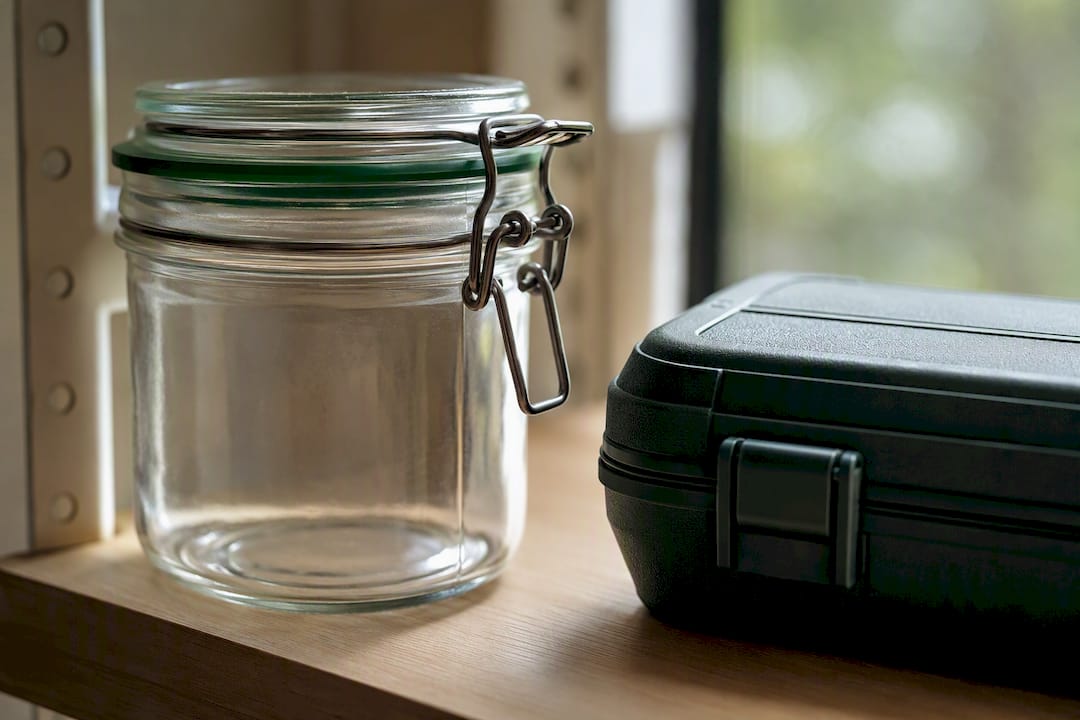
Reusable options fare better. A hard-shell case like the ones STASHLOGIX or DiscreetSmoker sell gets used hundreds of times before it needs replacing, which spreads its environmental cost over years instead of a single use. Glass jars are fully recyclable and, with a gasket swap, last indefinitely.
For businesses, the sustainability conversation increasingly includes recyclable mono-material films and post-consumer recycled content in outer boxes, even when the inner barrier layer stays foil-based for compliance reasons. If you’re a brand weighing this tradeoff, ask your packaging vendor directly whether they offer a mono-material or partially recyclable line. Not every manufacturer does, and the ones that do often charge a premium for it.
Consumers buying reusable carbon cases or glass jars are already making the lower-impact choice by default, simply because a container used for two years replaces dozens of single-use pouches.
What Makes Cannabis Packaging Design Stand Out on a Shelf?
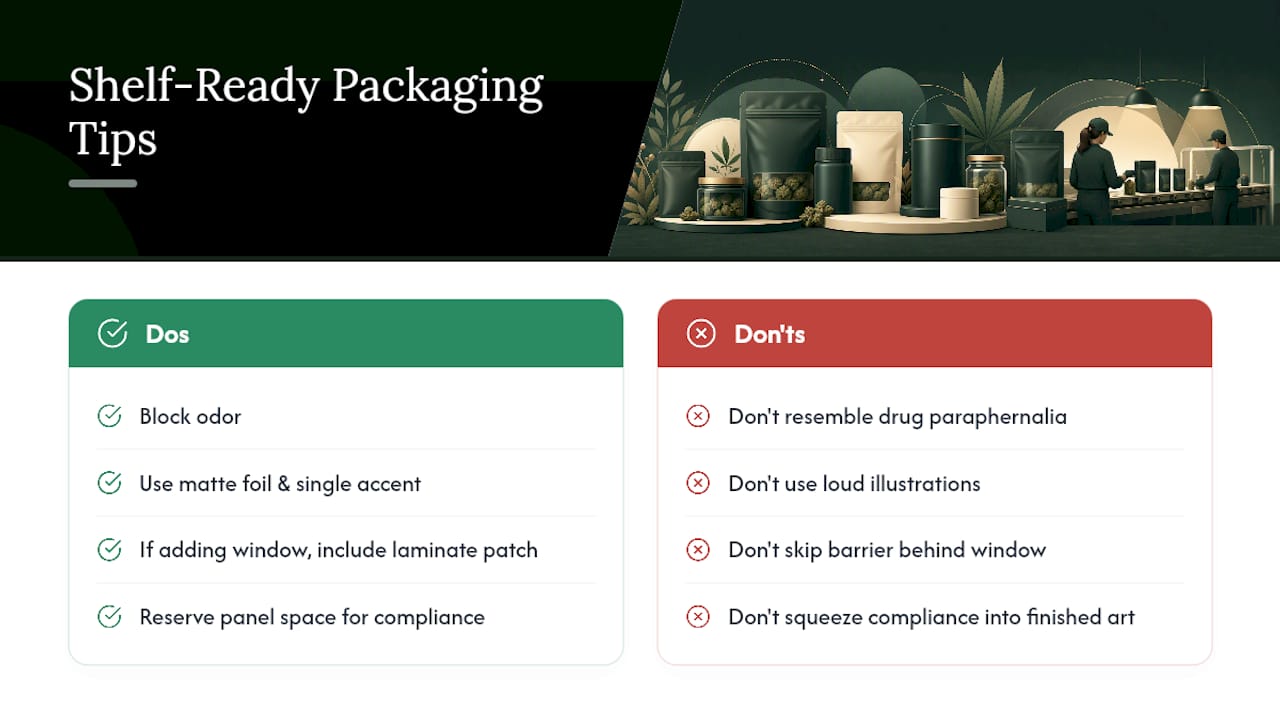
For a brand, packaging design has to do three jobs at once: block odor, survive shipping, and communicate what’s inside without looking like drug paraphernalia to a passerby. That last part is a real constraint. Discreet doesn’t mean unbranded. It means your logo and color scheme read as a normal consumer product, not a flag.
Matte foil finishes with a single accent color tend to outperform loud, illustration-heavy designs for retail shelf presence, mostly because they photograph cleanly for online menus and don’t compete visually with a dispensary’s other SKUs. Clear window cutouts are common on flower pouches, but every cutout is a small compromise on barrier performance, so brands that use them typically add a smaller laminate patch behind the window rather than skipping the barrier there entirely.
Compliance labeling eats a surprising amount of usable panel space: warning text, THC content, batch numbers, and a child-resistant symbol all have to fit without crowding the brand identity. Brands that plan for this early, rather than trying to squeeze compliance text onto a finished design, end up with cleaner packaging. If you’re sourcing custom runs, ask your vendor for a template that already reserves that space before you finalize artwork.
A Buyer’s Honest Take on Smell Proof Packaging
Consumers and businesses want almost opposite things from the same product category. A consumer cares about discretion, portability, and low maintenance, which usually points to a carbon-lined case or a small foil pouch that just works without a second thought. A business cares about compliance documentation, tamper evidence, MOQ logistics, and verified child-resistant closures, because a retail buyer or a regulator will ask for proof, not a marketing claim.
Some delivery services see this split from the delivery side: verified lab-tested products, sourced through a legal supply chain, arriving already packaged to standard. That’s a different kind of proof point than a spec sheet, but it’s the same underlying idea. Trust the paperwork, not the label copy.
— Jake
A Simpler Alternative to Packing It Yourself
If you’re weighing carbon cases against foil pouches because you need to move cannabis from point A to point B without anyone noticing, there’s a more direct fix: skip the transport problem entirely. Some services deliver licensed, lab-tested cannabis straight to your door across Alameda County, so you never have to solve the smell-proof packaging question for a trip to pick something up.
Orders ship through a legal supply chain with verifiable lab results, and local drivers handle delivery. That means no stash box, no zipper inspection, no wondering whether your car smells like flower after a stop. Whether you’re in Oakland, Berkeley, or elsewhere in the county, the packaging question becomes someone else’s job. Check same-day delivery across Alameda County to see what’s available near you, or browse current weed delivery in Berkeley options if that’s your area, and place an order today.
Sources
FAQ
Are there containers that are completely smell proof?
No container guarantees complete, permanent odor elimination. Foil laminate pouches, activated-carbon cases, and gasketed glass jars come closest when properly sealed and not overfilled, but seal integrity always sets the real limit.
Can drug dogs smell through smell proof bags?
Detection dogs are trained to find trace odors that leak through imperfect seals, packing residue, or repeated handling, so no consumer packaging should be treated as dog-proof. Even a high-barrier foil pouch only reduces detectable odor, it doesn’t eliminate the risk entirely.
What’s the difference between Mylar pouches and carbon-lined bags?
Foil laminate Mylar pouches block odor with a continuous metallic barrier layer and work best for one-time retail sealing. Carbon-lined bags adsorb odor molecules on contact, which makes them better for reusable, open-and-close daily carry.
Do I need child-resistant packaging as a cannabis business?
If you’re selling in a regulated market, your packaging very likely needs to meet child-resistant standards like ASTM D3475, regardless of how well it blocks odor. Confirm this with your packaging vendor rather than assuming a “smell proof” label covers compliance.
How can I verify a smell-proof claim before buying in bulk?
Request a laminate spec sheet, ask for a sample to run a 30-minute water submersion test, and check whether the vendor has published seal-integrity or child-resistance test results. A vendor unwilling to provide any of that is a red flag on its own.
Recommended
Ready to order?
Licensed, same-day cannabis delivery across Oakland, Berkeley, Fremont and all of Alameda County.
Order Online