
1–2.5 mg Microdosing Edibles: A Safety First Protocol
A safe edible microdose is usually 1 to 2.5 mg of THC, and it comes with two non-negotiable rules: start low, and wait at least two hours before taking any more. Some people need up to 5 mg to feel anything at all. The goal is subtle, functional relief, not a high.
TL;DR:
- Microdosing edibles typically involves 1 to 2.5 mg of THC, with a strict two-hour wait before dosing again to gauge effects accurately.
- Edibles pass through the liver, converting THC into a more potent metabolite, making even small doses feel stronger and last longer than smoked THC.
- Accurate microdosing requires using precisely dosed products like tinctures or pre-measured units, and avoiding unevenly divided homemade edibles.
- Effects at microdose levels are subtle and gradual, with most users experiencing mild mood or focus improvements rather than intoxication, which can be mistaken for overuse.
- Reliable lab-tested, licensed products ensure dosing accuracy and safety, especially in California, where batch-level lab results verify potency and contaminants.
Table of Contents
- What Counts as a Microdose of Edibles?
- How to Microdose Edibles: A Step-by-Step Protocol
- How Long Do Microdose Edibles Take to Kick In?
- Which Edible Formats Work Best for Microdosing?
- Risks, Side Effects, and Drug Interactions to Know
- Building a Schedule Without Building Tolerance
- Why Lab-Tested, Licensed Edibles Matter for Dosing Accuracy
- What Are the Legal Rules Around Microdosing THC Edibles?
- CBD vs. THC Microdosing: Which One Fits Your Goal?
- How Do You Know If a Microdose Is Actually Working?
- How to Safely Raise Your Microdose Over Time
- The Editorial Take: Why Most Microdosing Advice Skips the Hard Part
- Where to Find Lab-Tested, Low-Dose Edibles in Alameda County
- Sources
What Counts as a Microdose of Edibles?
Industry guidance splits THC edibles into three practical tiers: micro (1 to 2.5 mg), low (2.5 to 5 mg), and standard (5 to 10 mg or more). Most retail gummies are sold at 5 or 10 mg per piece, which means true microdosing usually requires splitting a product or buying one formulated specifically for low doses.
Edibles hit differently than smoking or vaping the same amount. When THC passes through the liver, it converts into 11-hydroxy-THC, a metabolite that crosses the blood-brain barrier more efficiently than inhaled THC does. That’s why 5 mg eaten can feel stronger and last longer than 5 mg smoked, and it’s the core reason to err lower than you’d expect with any edible.
A few practical ways to land in the microdose range:
- Cut a 5 mg gummy in half for a 2.5 mg starting dose.
- Use a tincture with a graduated dropper to measure 1 mg increments precisely.
- Buy pieces pre-dosed at 2.5 mg instead of eyeballing a cut from a bigger piece.
How to Microdose Edibles: A Step-by-Step Protocol
Treat your first few sessions like a small experiment, not a one-time decision. Here’s the sequence that keeps risk low while still giving you real data on what works for your body.
- Pick a reliable product. Choose something with clear per-piece labeling and available batch lab results, not a homemade edible or an unregulated gummy.
- Take 1 to 2.5 mg (start at 1 mg if you’re new to cannabis, sensitive to THC, or have a small body mass).
- Eat it with a light snack, not on an empty stomach and not with a heavy, fatty meal that will slow and intensify absorption.
- Set a two-hour timer. No redosing before it goes off, no matter how “nothing” feels at the 45 minute mark.
- Write down what happened. Note the time, the product and batch number, what you ate, and how you felt over the next several hours.
- Adjust only on a separate day, and only in small steps of 0.5 to 1 mg at a time.
This mirrors the step-by-step approach recommended by harm-reduction guides built specifically around edible dosing, and it’s the same logic seasoned users apply without necessarily writing it down.
Pro Tip: Tinctures give you far more control than gummies because you can measure in single milligrams. If you’re still calibrating your ideal dose, a dropper beats cutting candy into eighths.
If you’re uncertain where to start, lean toward the smaller number every time. You can always take more next time. You can’t take back an edible you’ve already swallowed.
How Long Do Microdose Edibles Take to Kick In?
Onset typically falls between 45 and 120 minutes, though some fast-acting formulations, like nanoemulsion gummies or beverages, claim effects in 5 to 15 minutes. Effects can keep building well after the first hour and may linger for 4 to 8 hours or longer at microdose levels, though the intensity should stay mild throughout if you dosed correctly.
Several things shift that timeline:
- A high-fat meal slows absorption but can also intensify the eventual effect.
- An empty stomach may speed onset but make effects less predictable.
- Formulation matters: fast-acting products behave differently than a standard baked good or hard candy.
The practical takeaway is simple: wait the full two hours before deciding whether to take more, and stretch that window longer if you ate a rich meal beforehand. Judging an edible at the 60 minute mark is one of the most common ways people accidentally double up and overshoot.
Which Edible Formats Work Best for Microdosing?
Not every edible on a shelf is built for precision. Single-piece products dosed at 1 to 2.5 mg, or tinctures with a marked dropper, give you the most control and the least guesswork. A tincture in particular lets you titrate by the milligram rather than committing to whatever a manufacturer baked into a single gummy.
What to avoid: cutting a high-potency chocolate bar into uneven pieces and assuming each chunk carries an equal dose. THC distribution in homemade or roughly-divided edibles is rarely uniform, and a “sliver” can carry two or three times the THC of the piece next to it. Only divide a product if the manufacturer explicitly confirms even distribution across the bar or piece.
When shopping, check for:
- Batch-specific lab results, not just a generic potency claim on the packaging.
- Clear labeling of per-serving THC versus total package THC, since these numbers get confused constantly.
- CBD:THC ratios on products that blend the two, since CBD can soften THC’s psychoactive edge for some users.
- Child-resistant packaging, which regulators treat as a baseline safety requirement, not an optional feature.
A strain guide that lists cannabinoid ratios alongside effects can help you match a product’s chemistry to what you’re actually trying to achieve, rather than guessing from a flashy label.
Risks, Side Effects, and Drug Interactions to Know
Even at 1 to 2.5 mg, some people notice mild dry mouth, slight drowsiness, or a subtle shift in appetite; for more information on safety considerations, see this CBD balm side effects resource. Signs you’ve gone past a microdose and into overconsumption territory include anxiety, dizziness, a racing heartbeat, or a heavy, foggy feeling that interferes with normal function. If any of those show up, the answer is time and patience, not another dose.
THC can interact with several medication classes through liver enzymes known as CYP450, which also metabolize many prescription drugs, including some blood thinners and anti-anxiety medications. If you take regular medication or have a psychiatric condition like anxiety or a history of psychosis, talk to a clinician before starting, even at low doses.
A few other realities worth stating plainly:
- Do not drive or operate machinery after any THC edible, regardless of how small the dose felt.
- Workplace drug screens don’t distinguish microdoses from regular use; THC metabolites can show up on a test for days or weeks.
- Store edibles in child-resistant containers, away from food that might confuse a curious kid or pet.
It’s worth being honest about the evidence base here, too. Observational studies on microdosing report improved mood and focus, but researchers flag heavy expectancy and placebo effects in that data, and a broader systematic review of microdosing research found extreme variation in study design and low overall certainty. Some of what people feel from a microdose may be real pharmacology; some of it is the power of ritual and expectation. Both can be useful, but neither should be mistaken for a clinically proven treatment.
Building a Schedule Without Building Tolerance
How often you dose depends on your goal, and each schedule trades off differently against tolerance.
- Every-other-day dosing (sometimes called the Fadiman protocol in microdosing communities) gives your body a rest day between doses, which limits tolerance buildup.
- Five days on, two days off mimics a workweek and gives you a predictable break every weekend.
- Daily dosing works for some wellness goals but raises tolerance fastest, meaning you may need to increase your dose over time just to feel the same effect.
- As-needed dosing avoids tolerance almost entirely but makes it harder to judge whether the edible or something else is driving how you feel on a given day.
Whatever schedule you pick, log it. A simple table with the date, product and batch number, dose, food eaten, onset time, and effects (both wanted and unwanted) turns guesswork into a pattern you can actually read after two or three weeks.
Why Lab-Tested, Licensed Edibles Matter for Dosing Accuracy
A microdose protocol only works if the product’s label is accurate. Batch-specific lab reports confirm the actual THC content per piece and screen for contaminants like pesticides or heavy metals, which matters because dosing errors and unregulated supply are a well-documented risk in the harm-reduction literature on edibles.
Greenonthegodelivery sources its menu exclusively through California’s licensed cannabis supply chain, which means every product on the menu carries verifiable batch lab results before it reaches your door.
When reading a lab report yourself, look for:
- Total THC and CBD potency per package and per serving, listed separately.
- Pass/fail results for pesticides, heavy metals, and residual solvents.
- A batch or lot number that matches what’s printed on your specific package.
If a retailer can’t produce that report on request, that’s a reason to shop elsewhere.
What Are the Legal Rules Around Microdosing THC Edibles?
Cannabis remains a Schedule I substance under federal law in the United States, even though a growing number of states, including California, have legalized adult-use cannabis for residents 21 and older. That gap between federal and state law matters for microdosing in a few concrete ways.
First, legality depends entirely on where you are, not on how small your dose is. A 1 mg edible is just as illegal to possess in a non-legal state as a 100 mg one; dose size has no bearing on legal status. Second, even within legal states, rules vary by city and county on delivery hours, packaging requirements, and where you’re allowed to consume in public.
Workplace and driving rules add another layer. Most states, California included, still prohibit driving under the influence of THC regardless of dose, and there’s no reliable “microdose exemption” written into DUI law anywhere. Employers can also maintain drug-free workplace policies that penalize any detectable THC, independent of state legalization or how little you consumed.
If you’re traveling, don’t assume a legal purchase in one state travels with you. Crossing state lines with cannabis, even a small quantity of low-dose edibles, can trigger federal law regardless of either state’s local rules. And packaging matters legally, not just practically: most legal markets require child-resistant, clearly labeled packaging as a condition of retail sale, which is part of why buying from licensed sources protects you on more than one front.
CBD vs. THC Microdosing: Which One Fits Your Goal?
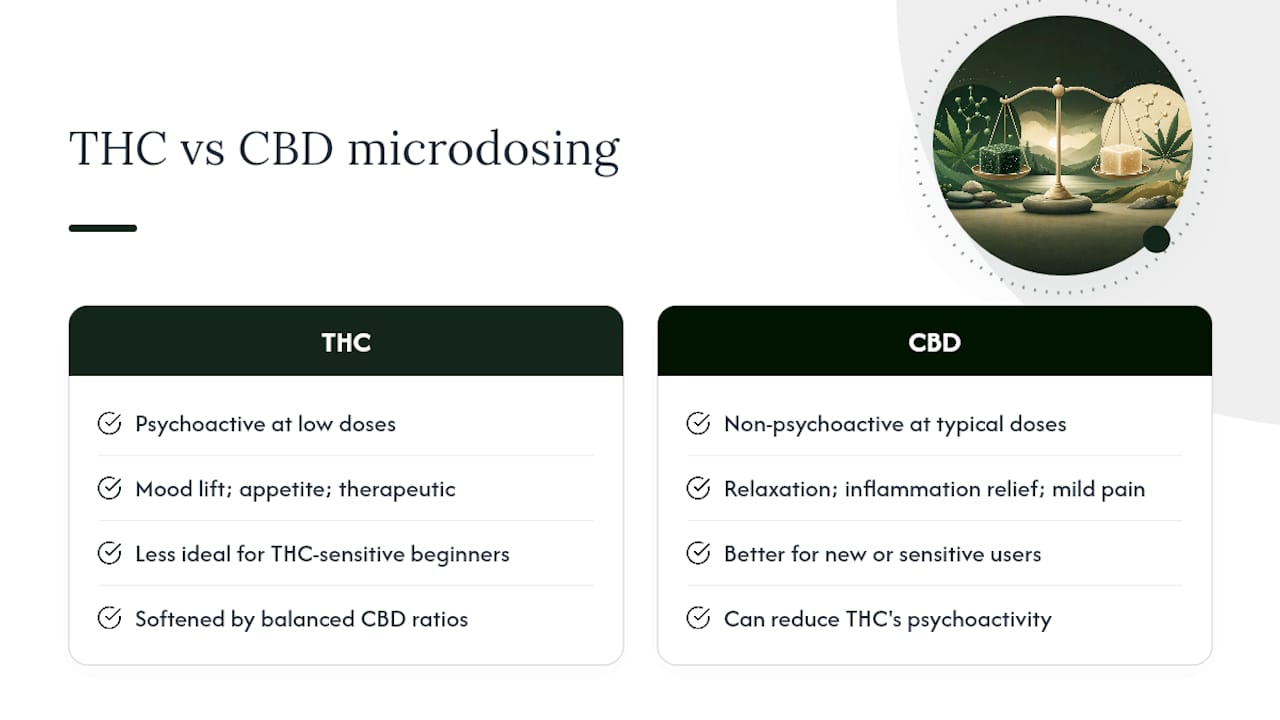
THC and CBD produce genuinely different experiences even at low doses, and confusing the two leads to disappointing results either way. A THC microdose, even at 1 to 2.5 mg, still engages the same receptors responsible for intoxication, just at a low enough level that most people don’t feel impaired. CBD, by contrast, doesn’t produce a psychoactive effect at typical doses, working through different receptor pathways tied more to relaxation and inflammation response than to mood-altering intoxication.
That difference shapes who should reach for which. If your goal is a subtle mood lift, mild pain relief, or gentle relaxation without any risk of feeling “off,” a low-THC or CBD-forward product may get you there with less variability session to session. If you’re chasing a specific therapeutic effect that anecdotal reports tie more closely to THC itself, such as appetite support or a particular kind of mental ease, a true THC microdose is the more direct route.
Combining the two is common practice and worth understanding rather than avoiding. Products with a balanced CBD:THC ratio, such as 1:1 or 2:1 CBD to THC, tend to soften the psychoactive edge of THC for many users, which can make the overall effect feel more predictable at low doses. This isn’t universal. Some people find CBD does little to change their THC experience, and response varies by individual body chemistry.
If you’re newer to cannabis or particularly sensitive to THC’s intoxicating effects, starting with a CBD-dominant or balanced product before moving to THC-only microdoses gives you a gentler on-ramp. A strain profile with a documented cannabinoid ratio makes that comparison easier than guessing from a generic label.
How Do You Know If a Microdose Is Actually Working?
The signs of an effective microdose are quiet, almost boring: a slightly softened edge to stress, a bit more ease focusing, a mild sense of calm you might not even notice unless you’re paying attention. That’s the point. If you can clearly tell you’re “high,” you’ve overshot the target.
Overconsumption looks different and is usually unmistakable once it starts. Racing thoughts, noticeable anxiety, a spinning or dizzy feeling, a rapid heartbeat, or a heavy, sedated fog that pulls you out of normal activity are all signs you took too much, not signs of a strong microdose. If that happens, the only real response is time, water, a calm environment, and patience until it passes.
Managing expectations matters as much as managing the dose itself. Microdosing isn’t designed to produce a dramatic before-and-after; it’s designed to nudge a baseline slightly, which means the effect can be genuinely hard to isolate from placebo, mood, sleep, or whatever else is happening in your day. That’s exactly why a log matters more here than with a stronger, more obvious dose. Without tracking, it’s easy to either dismiss a real subtle benefit as “nothing” or credit an edible for a good day that had nothing to do with it.
Give any new dose at least three or four separate sessions before drawing conclusions. One session tells you almost nothing; a pattern across several tells you what’s actually happening.
How to Safely Raise Your Microdose Over Time
If 1 mg does nothing after several honest attempts, the next step isn’t to double it. Raise your dose in increments of 0.5 to 1 mg, and change only one variable between sessions, never dose and food and timing all at once. That’s the only way to know which change actually caused a difference in how you felt.
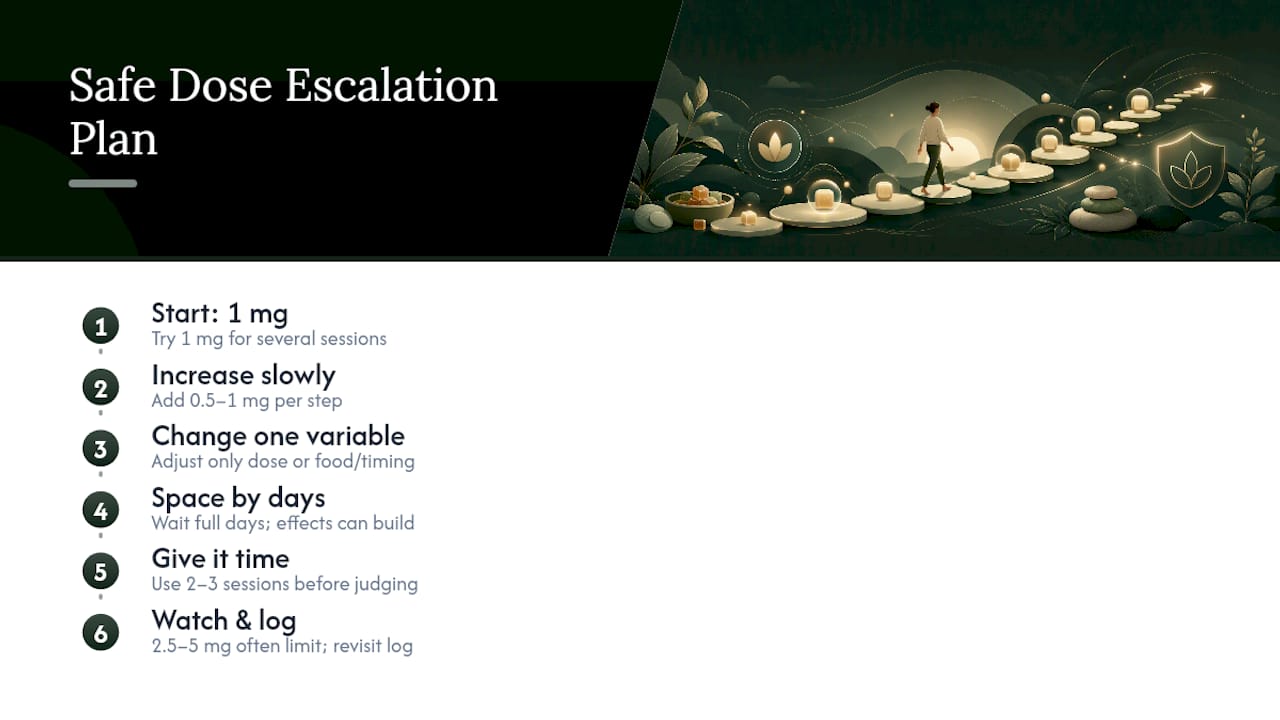
Space your increases across separate days, not separate hours. Because edibles can take up to two hours to fully register and effects can keep building afterward, adjusting within the same day means you’re often reacting to a dose that hasn’t finished working yet. Give each new amount at least two or three sessions before deciding whether it’s your number or whether you need to go higher still.
Watch for the point of diminishing returns, which for most people building toward a therapeutic effect sits somewhere between 2.5 and 5 mg. Beyond that range, many people start noticing more noticeable psychoactive effects without a proportional gain in whatever benefit they were chasing. That’s a signal you’ve likely crossed from microdosing into low-dose territory, which isn’t wrong, just a different goal than what most microdosers set out for.
Your optimal dose isn’t fixed forever, either. Body weight changes, tolerance from regular use, stress levels, and even the specific product’s formulation can shift what “works” from one month to the next. Revisit your log periodically rather than assuming the number you landed on in January still applies in Chocolate Chip season or any other point down the line.
The Editorial Take: Why Most Microdosing Advice Skips the Hard Part
Most guides to microdosing edibles love the aspirational part: the calm focus, the subtle mood lift, the promise of relief without a high. What they gloss over is that the actual evidence for those benefits is thin, propped up largely by observational reports where expectancy and placebo effects are doing real work alongside whatever THC is doing.
That’s not a reason to dismiss microdosing. It’s a reason to treat it like the experiment it actually is, rather than a guaranteed protocol you can copy from a blog and expect identical results. The two-hour rule and the habit of logging your sessions aren’t bureaucratic overkill. They’re the only tools that separate a real personal pattern from wishful thinking.
The part I’d push back on hardest is how casually some sources treat product variability. A gummy cut unevenly, or bought from a source with no batch testing, turns your careful 1 mg protocol into a guess. Precision in dosing means nothing if the label lying to you is the actual variable. Start conservative, track honestly, and buy from sources that can prove what’s in the product before you decide whether microdosing is working for you at all.
— Jake
Where to Find Lab-Tested, Low-Dose Edibles in Alameda County
There are practical alternatives to guessing at gas-station gummies or splitting an oversized chocolate bar and hoping the pieces are even. Every edible on the menu comes through California’s licensed supply chain with batch lab results available before you buy, which is the single most useful thing you can check when you’re trying to hit a precise 1 to 2.5 mg dose.

If you’re just starting out, look for pre-dosed low-mg units or a tincture rather than a standard 10 mg bar you’d need to cut into eighths. Check the batch lab report for potency per piece before you order, and pair that with a strain guide if you want to match cannabinoid ratios to your goal. Same-day delivery is available across Alameda County, including Berkeley and Dublin. Browse the current menu and place an order through Greenonthegodelivery’s ordering page to get lab-verified, low-dose edibles delivered to your door today.
This article is general information, not a substitute for advice from a qualified doctor. Consult a qualified healthcare professional about your own circumstances before acting on anything here.
Sources
- Why people microdose edibles: how low thc doses affect mood and focus | Weedmaps
- Observational microdosing study (PMC6364961)
- The Complete Guide to Microdosing Cannabis Edibles | EdibleRank
- Systematic review on microdosing (Frontiers, 2026)
Recommended
Ready to order?
Licensed, same-day cannabis delivery across Oakland, Berkeley, Fremont and all of Alameda County.
Order Online