Legal vs. Illegal Weed Delivery in California: How to Tell
Legal weed delivery in California comes from a state-licensed retailer, arrives in person in an enclosed vehicle, and starts with a driver checking your government ID. Illegal delivery is everything else: a social media menu, a stranger with no license paperwork, a package in the mail. The two can look alike on your phone screen, but the differences are easy to check once you know where to look. This guide covers what the law requires, what you should see at your door, and what is at stake for the people running unlicensed operations. At Green On The Go, we deliver licensed, lab-tested cannabis across Alameda County, so these checks are the standard we work to every day.
TL;DR
- Legal delivery in California comes from a licensed retailer, to adults 21+ (or 18+ with a physician’s recommendation), with a government photo ID check at the door.
- Licensed drivers carry a copy of the retailer’s license and a state QR code certificate, and deliver in an enclosed vehicle with no cannabis visible.
- Licensed products carry required warnings, tamper-evident packaging, a THC label and lab testing. Licensed edibles are capped at 10 mg THC per serving and 100 mg per package.
- Cannabis cannot be mailed or taken across state lines, because it remains illegal under federal law.
- Unlicensed sales carry criminal and civil penalties for the seller, and they leave the buyer with untested product and no recourse.
Table of Contents
- What makes weed delivery legal in California
- What a legal delivery looks like at your door
- Red flags of illegal weed delivery
- How to verify a delivery service in about five minutes
- Does your city’s ban matter?
- What the law does to unlicensed sellers
- What you risk as a buyer
- Legal delivery versus picking up in person
- Where Green On The Go fits
- Our perspective on legal delivery
- FAQ
- Sources
What makes weed delivery legal in California
California is one of the few states where direct-to-consumer recreational delivery is authorized. A peer-reviewed review of state delivery laws in the American Journal of Public Health found that, as of July 1, 2024, only 14 states authorized direct recreational delivery to adults, California among them. Many other states with legal cannabis still require you to go to a store.
In California, the Department of Cannabis Control (DCC), the state regulator, says cannabis is legal for adults 21 and older, or for people 18 and older with a physician’s recommendation for medicinal use. It also says customers can order online from licensed retailers for delivery. The key word is licensed. Delivery is legal when it is run by a retailer holding a state license, with trained staff, tracked inventory and tested product.
Three things define the legal version:
- A state license. The retailer holds an active license from the DCC, and the license covers delivery.
- Regulated product. Everything sold has passed through the licensed supply chain: grown, tested, packaged and labeled under state rules.
- A compliant handoff. The driver is an employee of the retailer, verifies your age and ID, and delivers in person.
If any of the three is missing, you are dealing with an illegal operation, however polished its menu looks.
What a legal delivery looks like at your door
California is specific about how a licensed delivery must work. The California Highway Patrol’s General Order 70.16, issued in December 2024 to guide officers, lays out the rules licensed drivers follow:
- Deliveries are made in person, by an employee of the retailer who is at least 21.
- The driver uses an enclosed motor vehicle, and the cannabis cannot be visible from outside it.
- The driver carries a copy of the retailer’s license, the DCC QR code certificate, a government ID and an employee ID.
- A driver may not carry more than $10,000 worth of cannabis goods at a time.
The League of California Cities’ Seed to Sale guide adds that delivery vehicles must have no exterior cannabis markings, goods must be locked in an enclosed container, the vehicle needs a dedicated GPS, and drivers cannot deliver to publicly owned land or public-agency buildings.
On the customer side, the DCC says retailers verify age with a government photo ID, military photo ID or passport. Deliveries and in-store sales both end by 10:00 p.m., and drivers must be back by then, so a seller promising 2 a.m. delivery is not following state hours. Cities and counties can set stricter hours. For a plain-language rundown of what to hand the driver, see our guide to weed delivery ID requirements in California.
Why you must be home and ready
Because the driver has to hand the order to you personally and check your ID, a legal delivery cannot be left on a porch or with a neighbor. This is a feature, not a hassle: it is how the law keeps cannabis away from minors. If you have to move the drop-off, it helps to know what to do about a delivery address change before the driver is on the way.
Red flags of illegal weed delivery
Unlicensed sellers are not always obvious. Some copy the look of real shops. These are the signs that separate them:
- No license number anywhere. A licensed retailer can tell you its license and you can look it up.
- Ordering through direct messages or a social media account only. A real retailer has a site or phone line tied to a business name and address.
- No ID check. If a seller will deliver to anyone, at any hour, without asking for age verification, it is not following the law.
- Unmarked products in baggies or jars. Licensed products come in sealed, labeled packaging.
- Shipping by mail or courier. Cannabis cannot lawfully travel by mail or carrier. The DCC notes cannabis cannot be taken across state lines because it remains illegal under federal law, which is also the answer to the common question of whether getting weed shipped is legal. It is not.
- Prices far below the market. Cannabis sold without taxes, testing and licensing costs can be cheap for a reason.
- Cash only, with a meetup spot instead of your address. Licensed delivery goes to a verified address.
A word on the “illegal” label itself. Federal law still classes cannabis as illegal, but California’s licensed system operates under state law, and the rules above apply to anyone buying within the state. What you control is whether your purchase goes through that system.
How to verify a delivery service in about five minutes
California gives consumers real tools for checking, and using them costs nothing. A consumer checklist built from DCC guidance recommends the following steps before you buy.
- Look up the license. The DCC runs a public license search. Search the retailer’s name or license number and confirm the status reads Active, and that the business name and address match what you were told. The license must be a retail license that covers delivery, often called a non-storefront retail license.
- Ask for the QR code certificate. Licensed shops post a DCC QR code certificate in the window, and delivery drivers carry a copy. Scanning it takes you to the state’s record for that license.
- Read the package. Licensed products come in child-resistant, tamper-evident packaging with the required symbol and warnings, a clear THC amount, and batch or UID information that can be used for recall checks.
- Check the numbers. Licensed edibles are capped at 10 mg THC per serving and 100 mg per package. A gummy marked 50 mg per piece did not come through the legal system.
- Confirm the testing. Products must be tested by a licensed lab for pesticides, heavy metals, microbes, mycotoxins and solvents before sale. Our walkthrough on how to verify cannabis lab results shows how to read a certificate of analysis.
If you want to confirm the rules for Oakland specifically, the City of Oakland publishes its cannabis operator regulations, updated in April 2025, and lists a cannabis permit office contact for questions.
Does your city’s ban matter?
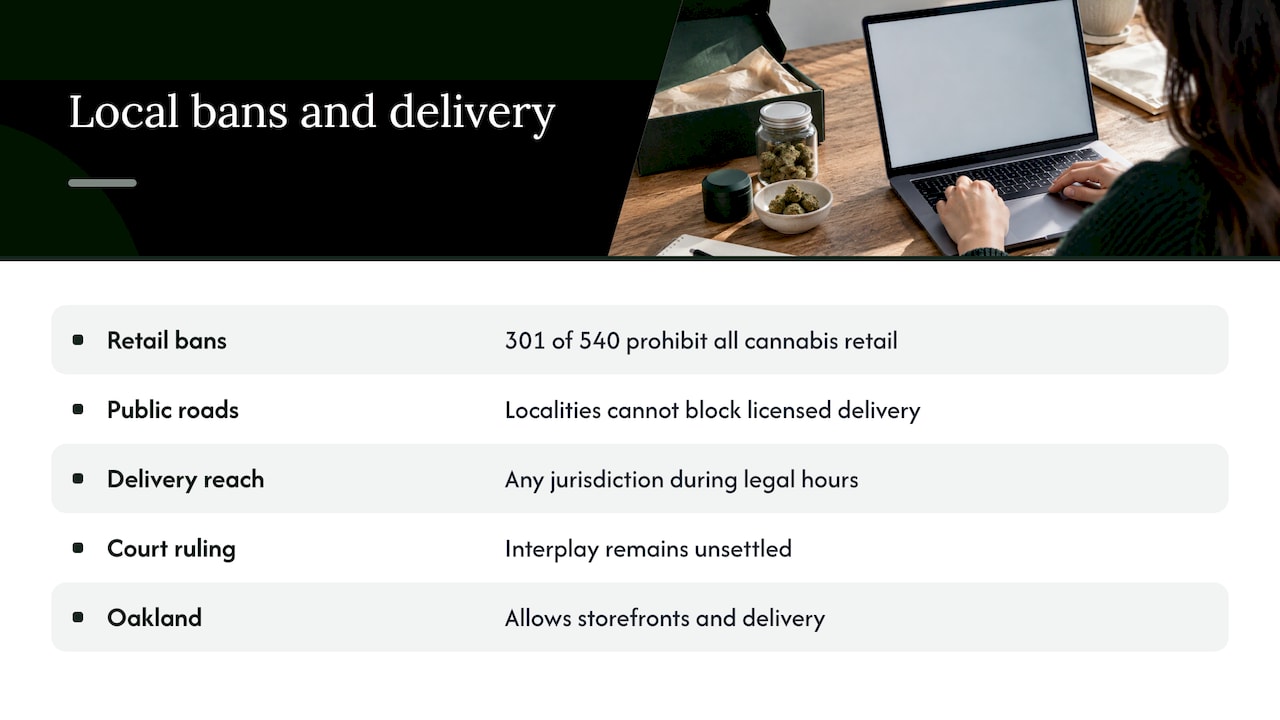
This trips up many readers. California has hundreds of cities and counties, and many prohibit cannabis storefronts. The Cannabis Health & Safety Alliance, comparing against DCC data in October 2026, reports that 301 of 540 California cities and counties prohibit all cannabis retail. The same page notes that state law says a city or county cannot stop licensed delivery from using public roads, and it lists Oakland as allowing both storefronts and delivery.
CHP’s guidance says a licensed delivery employee may deliver to any jurisdiction in California during legal hours, regardless of local rules. The League of California Cities points out that cities still keep practical control over businesses operating inside their borders, and that the interplay between state regulation and local bans has not been settled by a published court ruling. For you as a customer in Oakland, Berkeley, Fremont or Dublin, the practical point is simple: order from a licensed retailer, and the delivery is lawful. Our delivery areas page lists the Alameda County cities we serve.
What the law does to unlicensed sellers
You are not the one the penalties are designed for, but knowing them explains why legitimate operators invest in compliance and why unlicensed ones disappear.
- Criminal exposure. Monterey County’s public health office summarizes California law: unlicensed sale or transport for sale can be a misdemeanor punishable by up to six months in county jail and a $1,000 fine, and it can become a felony for people with prior serious violent felonies or a history of selling cannabis.
- Administrative fines. The League of California Cities reports DCC fines of up to $5,000 per violation for licensees and up to $30,000 per violation for unlicensed operators.
- Civil penalties. AB 195 allows civil penalties for unlicensed commercial cannabis activity of up to three times the license fee per violation, with each day counted separately, and up to $30,000 per violation for aiding and abetting. Courts can also order the cannabis destroyed.
CHP’s enforcement guidance directs officers to treat unlicensed commercial delivery as a potential violation of Health and Safety Code Section 11360, and to refer unlicensed delivery activity to the DCC’s enforcement branch. The same guidance says the mere presence of a legal amount of cannabis cannot be the sole basis for a search, so lawful adults carrying their own purchase are not the target.
What you risk as a buyer
Buying from an unlicensed seller rarely lands a customer in legal trouble. The real costs are practical:
- Unknown contents. Without state-required testing, you cannot know whether flower carries pesticides or mold, or whether a vape cartridge contains what the label says.
- Inconsistent dosing. Edibles and concentrates without regulated labeling make it easy to take far more than you meant to, a common problem for first-time users.
- No recourse. A licensed retailer has a business, an address and a license at stake. A stranger on a messaging app has none of those.
- Safety at the door. Meeting an unverified seller means giving out your address or going somewhere unfamiliar.
For first-time users especially, regulated labeling is the point. A clear THC amount and a 10 mg serving cap make a first experience far easier to manage. If you are unsure what to look for, our explainer on THC versus CBD is a sensible starting place, and our guide to California possession limits covers how much you can carry once your order arrives.
Legal delivery versus picking up in person
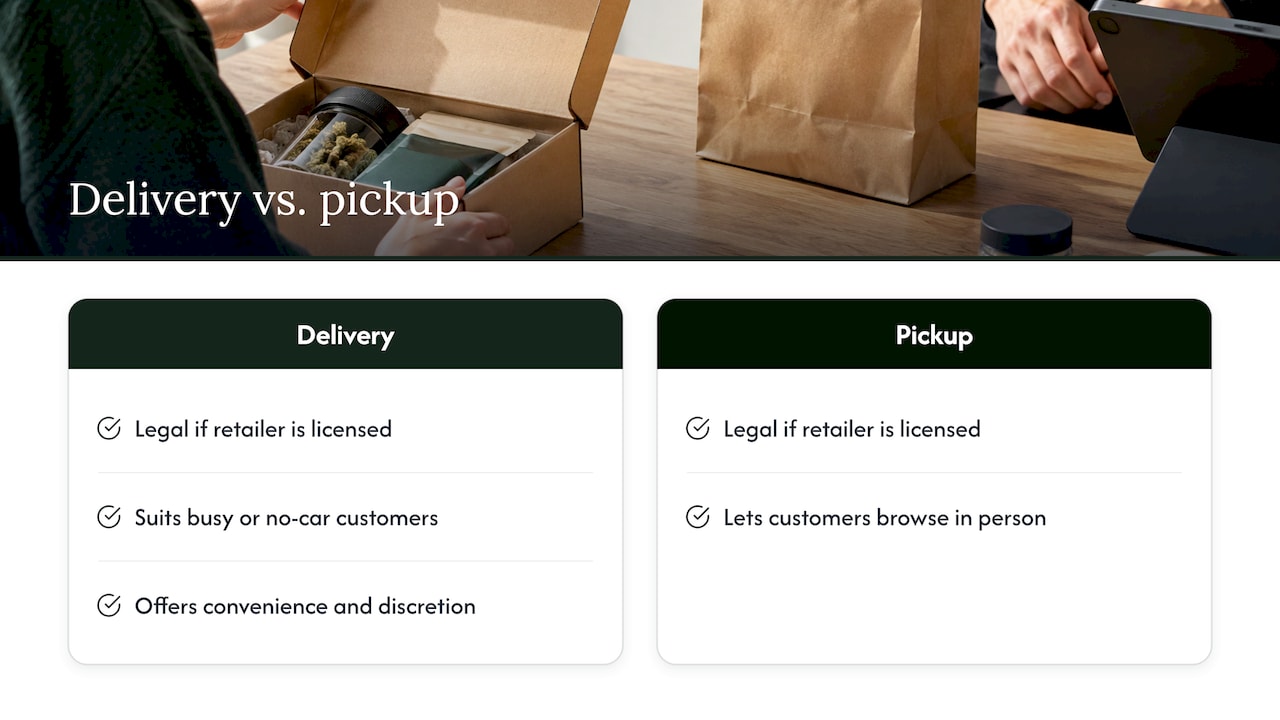
Both are legal when the retailer is licensed. The difference is convenience and discretion. Delivery suits busy professionals, people without a car and anyone who prefers not to run errands, while pickup suits those who want to browse in person. We compare the two in delivery vs. pickup for weed. If you are ordering for a workplace, note that California’s rules and your employer’s policies are separate things, which our page on workplace weed delivery explains.
Where Green On The Go fits
Green On The Go is a cannabis delivery service based in Alameda County that delivers licensed, lab-tested products same day across the county’s cities. Our menu is curated from trusted California brands, including STIIIZY and Buddies, so batch consistency is something you can expect, and every product comes through a legal supply chain with verifiable lab results. Our drivers are local and know the East Bay, which keeps deliveries fast and discreet. You can browse flower, pre-rolls, vaporizers, concentrates, edibles and accessories on our menu and place an order on our same-day delivery page.
Living in Dublin or Berkeley? We have pages for weed delivery in Dublin and weed delivery in Berkeley with local details.
Our perspective on legal delivery
Most people who ask about legal versus illegal delivery are not trying to be experts in regulation. They want to know that what shows up at their door is safe and is what the label says. That is the whole case for the licensed system.
We think the best sign of a legitimate service is that it makes verification easy. Verifiable lab results, a menu of brands with a track record and batch consistency, and local drivers who know the neighborhoods they serve: that is how we run delivery in Alameda County. We want you to be able to check us, and we want the order to be uneventful.
If you are new, start with a lower dose and read the label. If you are experienced, you probably already know that consistency from one batch to the next is what keeps you coming back to a source. Either way, ordering from a licensed delivery service is the simplest way to get both.
Jake
FAQ
Is it illegal to get weed shipped to me?
Yes, mailing cannabis through the postal service or carriers is not allowed, because cannabis is still illegal under federal law and cannot cross state lines. In California, the lawful route is delivery by a licensed retailer’s own employee, in person, within the state.
Can a delivery driver leave my order at the door?
No. Licensed deliveries are made in person to an adult whose age and ID have been checked. You need to be at the address with your government photo ID, military ID or passport ready.
What hours can legal weed delivery run in California?
California retailers may sell cannabis between 6:00 a.m. and 10:00 p.m., and delivery drivers must return by 10:00 p.m., according to the DCC. Cities and counties can set stricter hours, so a retailer’s own hours may be shorter.
How do I know a delivery service has a real license?
Search the business in the DCC’s public license search and confirm the status is Active and that the name and address match. Licensed drivers also carry the retailer’s license copy and a DCC QR code certificate, and the products in your bag should have compliant labels and warnings.
Sources
- US State Recreational and Medical Cannabis Delivery Laws, American Journal of Public Health review
- What’s legal, California Department of Cannabis Control
- Retail, California Department of Cannabis Control
- General Order 70.16, California Highway Patrol
- Seed to Sale guide, League of California Cities
- Before you buy checklist, Cannabis Health & Safety Alliance
- Where is licensed cannabis retail allowed in California, Cannabis Health & Safety Alliance
- Cannabis Operator Regulations, City of Oakland
- Cannabis Education Laws, County of Monterey
- AB-195 Cannabis, California Legislative Information
Recommended
Ready to order?
Licensed, same-day cannabis delivery across Oakland, Berkeley, Fremont and all of Alameda County.
Order Online