Edibles vs Smoking: Heart Study Finds Harm, Practical Safety Tips
Edibles produce a slower, longer, and often stronger high because the liver converts THC into 11-hydroxy-THC; smoking gives fast, easy-to-control relief but exposes your lungs to combustion byproducts. Edibles take 30 to 120 minutes to kick in and can last 6 to 12 hours or more, while smoking or vaping works in minutes and clears the system faster. Neither route is safer across the board. The right choice depends on your goals, your lungs, and how well you can wait out an edible before taking more.
TL;DR:
- Edibles typically take 30 to 120 minutes to produce effects that last 6 to 12 hours, whereas smoking or vaping start within minutes but last only 1 to 3 hours.
- Combining edibles with alcohol or other medications can increase health risks or cause unpredictable interactions due to THC’s liver processing effects.
- Untested homemade edibles pose a higher overdose risk, so using lab-tested, labeled products with accurate dosing is essential for safety.
- Both routes increase cardiovascular risks, regardless of delivery method, and impair driving and other safety-critical tasks for several hours.
- Edibles are preferable for lung health and discretion, but they require careful dosing, patience, and awareness of delayed onset to avoid overconsumption.
Table of Contents
- Edibles vs. Smoking: How Each Route Gets THC Into Your Body
- How Do the Health Risks of Edibles and Smoking Compare?
- Dosing and Safety: What Actually Reduces Your Risk
- Choosing Between Edibles and Smoking for Your Situation
- Harm Reduction and What to Do If Someone Overdoses
- Do Edibles and Smoking Feel Different Beyond Just Timing?
- Can Edibles or Smoking Affect Driving and Other Safety-Critical Tasks?
- How Do Laws Differ Between Edibles and Smoking?
- What Environmental and Social Factors Shape the Choice?
- Which Costs More: Edibles or Smoking?
- What This Comparison Gets Wrong in Most Cannabis Advice
- Where to Find Reliably Labeled, Lab-Tested Products
- Sources
Edibles vs. Smoking: How Each Route Gets THC Into Your Body
The difference between an edible high and a smoking high comes down to one organ: the liver. When you smoke or vape, THC crosses directly from your lungs into your bloodstream, reaching the brain in a matter of minutes. When you eat an edible, THC has to survive your stomach and pass through the liver before it reaches general circulation, and that detour changes almost everything about the experience.
Inhalation is fast because it skips digestion entirely. Smoked cannabis reaches peak blood concentration within about 10 minutes, and effects are usually noticeable before you’ve finished the first exhale. Bioavailability, meaning the percentage of THC that actually makes it into your bloodstream, ranges widely with smoking, generally landing somewhere between 10% and 35% depending on how deeply you inhale and how experienced you are at not wasting a hit. Vaporizing tends to land at the higher end of that range because it heats cannabis without burning it, which preserves more THC than combustion does.
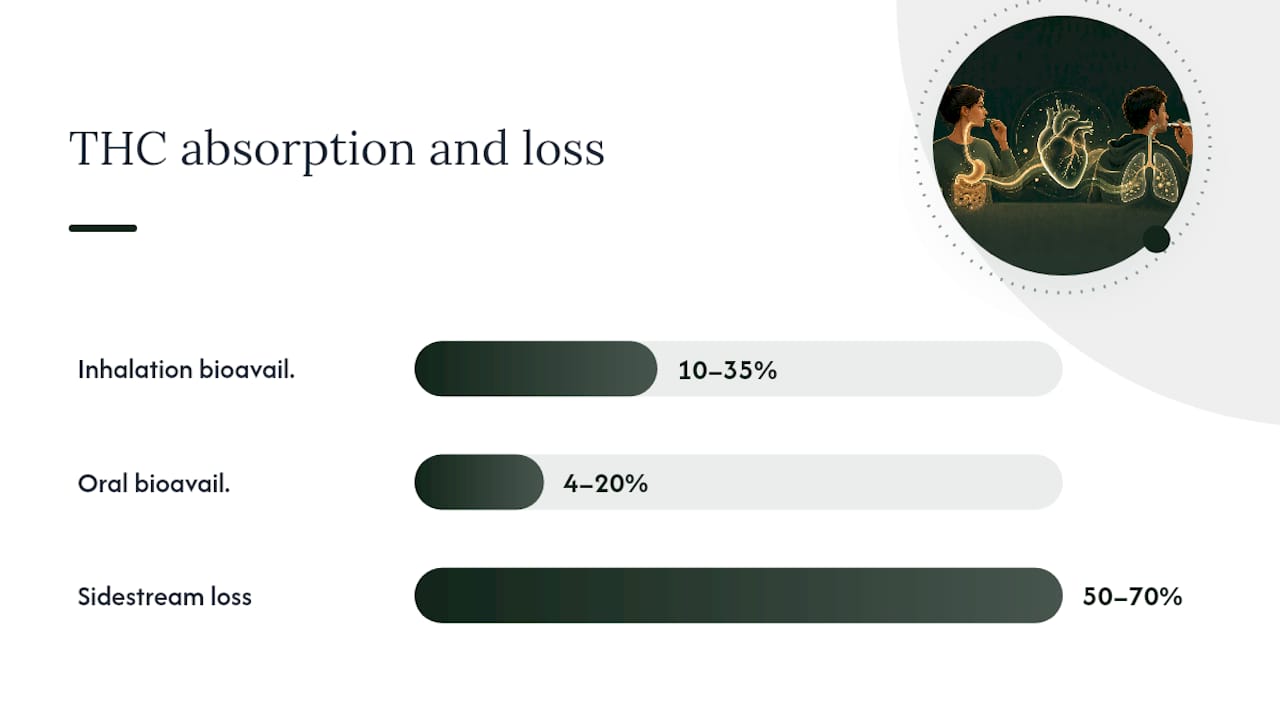
Combustion wastes a surprising amount of the drug you’re paying for. Estimates from pharmacology reviews suggest that 50% to 70% of THC in a smoked joint is lost to sidestream smoke and heat destruction before it ever reaches your lungs. That statistic alone explains why two people smoking the same strain can report wildly different highs. It also explains why vaping has become popular among people managing tolerance or budget: less of the drug goes up in smoke, literally.
Edibles work on a completely different clock. Once swallowed, THC travels through the stomach and small intestine, then gets pulled into the liver before it enters the bloodstream. That’s the first-pass hepatic effect, and during this process, enzymes convert delta-9 THC into 11-hydroxy-THC, a metabolite that crosses the blood-brain barrier more efficiently and binds more strongly to CB1 receptors than the original compound. That’s the mechanical reason edibles hit harder and last longer than smoking the same nominal dose. It also explains why “I only ate one gummy” so often turns into a much rougher night than the label suggested.
A few concrete numbers help frame this:
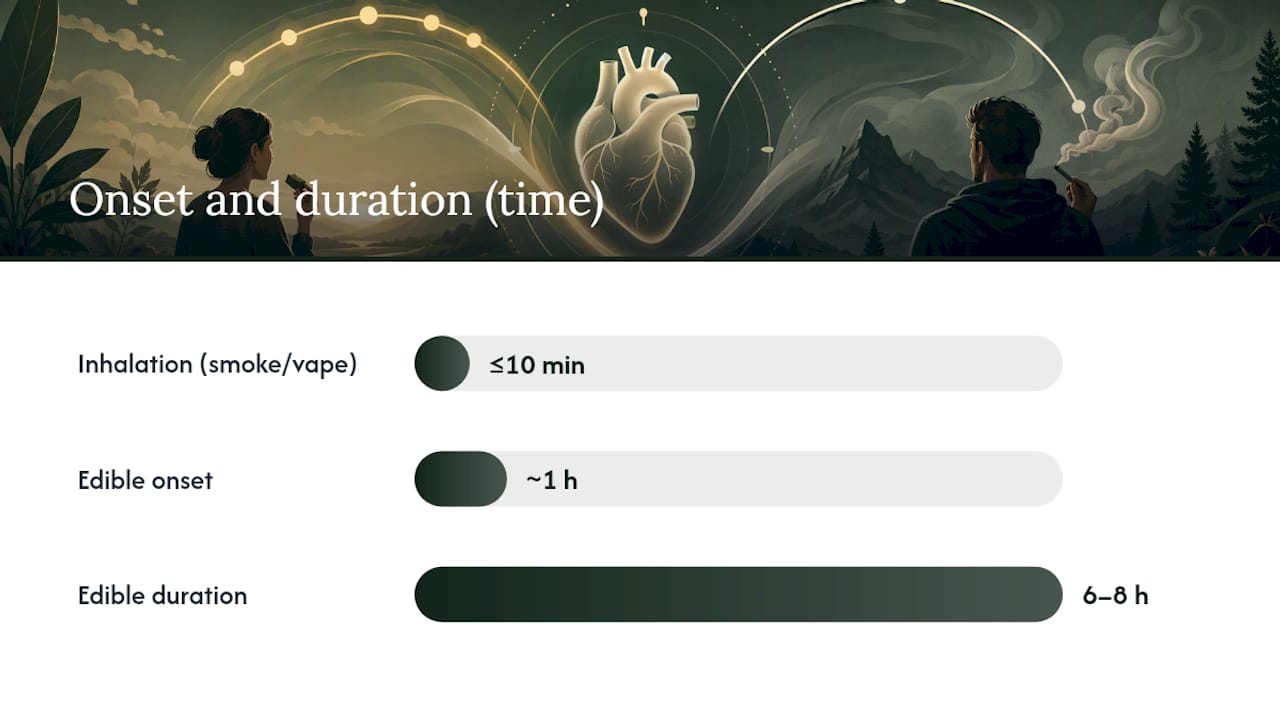
- Smoking or vaping: onset in 1 to 10 minutes, peak effects around 30 minutes, total duration 1 to 3 hours.
- Edibles: onset in 30 to 120 minutes, peak effects at 2 to 4 hours, total duration 6 to 12 hours or longer for high doses.
- Oral bioavailability of THC is generally lower than inhalation, often cited between 4% and 20%, but the 11-hydroxy-THC conversion means a lower percentage absorbed can still produce a stronger subjective effect.
- Sublingual tinctures split the difference, with partial absorption under the tongue producing a faster onset than a swallowed edible without the full lung exposure of smoking.
None of this makes one route objectively better. It makes them mechanically different products that happen to share an active ingredient, which is exactly why treating a 10 mg gummy like a single puff off a joint is the most common mistake new users make.
How Do the Health Risks of Edibles and Smoking Compare?
Smoking and edibles fail you in different ways, and the evidence on each has gotten sharper in recent years.
Smoking’s biggest liability is your respiratory tract. Burning plant material, cannabis or otherwise, produces tar and particulate matter that irritate airway tissue. Peer-reviewed research summarized in a PMC review of smoking, vaping, and edible use links regular cannabis smoking to increased bronchitis symptoms and chronic airway irritation, patterns that closely mirror what’s seen in tobacco smokers, even though cannabis smoke and tobacco smoke aren’t chemically identical. Vaping reduces this specific risk because it heats cannabis oil or flower below the combustion point, cutting down on tar production, but it isn’t risk-free. Vape hardware introduces its own variables: heavy metals leaching from cheap heating coils, cutting agents in low-quality cartridges, and inconsistent temperature control that can degrade oils into harmful byproducts.
Edibles shift the danger from your lungs to your judgment. Because the effects take so long to appear, people routinely eat a second or third dose before the first one has finished absorbing, stacking peaks they never intended to stack. Clinical and hospital data reported by UCHealth show marijuana-related emergency room visits climbing sharply in recent years, with edibles drawing specific concern because of delayed onset and potent liver-converted effects that catch users off guard. The acute symptoms in these visits tend to be psychiatric rather than respiratory: severe anxiety, paranoia, racing heart, and occasionally chest pain that sends someone to the ER convinced something is seriously wrong, even though cannabis overconsumption is rarely medically dangerous on its own.
A 2025 cardiology finding worth taking seriously: A study reported by UCSF and published in JAMA Cardiology found that regular cannabis users, whether they used edibles or smoked, showed vascular function reduced by roughly half compared to non-users. That’s a meaningful signal about cardiovascular strain that shows up regardless of route, and it should reframe any assumption that switching from smoking to edibles solves the cardiovascular question. It doesn’t. It just changes which risks are on the table.
Some risks don’t discriminate by route at all. The World Health Organization’s guidance on cannabis and public health notes that impaired driving, cognitive effects, cannabis-use disorder risk, and pregnancy-related harms track with total dose and frequency of use, not with whether the THC arrived through your lungs or your stomach. A daily high-dose edible user and a daily high-dose smoker face overlapping risks on most of these fronts.
Special populations need tighter margins on both routes. Pregnant individuals should avoid cannabis entirely, given documented links between prenatal exposure and developmental concerns. Adolescents face elevated risk for cognitive and mental health effects because their brains are still developing, regardless of delivery method. People with existing heart or lung disease carry extra risk from either route, smoking for the obvious respiratory burden, edibles for the cardiovascular strain the UCSF findings highlight and for interactions with heart medications. And anyone on multiple prescriptions, particularly older adults, faces a less obvious hazard: edibles processed through the liver can interact with drugs metabolized by the same CYP450 enzyme pathways, occasionally amplifying or blunting medication effects in ways that are hard to predict at home.
Dosing and Safety: What Actually Reduces Your Risk
Most bad experiences with either route trace back to one thing: not knowing how much you actually took before you felt anything.
- Start at 2.5 mg THC for edibles, no matter your tolerance. Public-health guidance from the Canadian Centre on Substance Use and Addiction recommends this starting point even for people who consider themselves experienced, because oral THC’s delayed and variable absorption makes tolerance built from smoking a poor predictor of how you’ll respond to a gummy or chocolate. Experienced edible users often land in the 5 to 15 mg range for a comfortable, functional effect, but that number should be earned over multiple sessions, not assumed on day one.
- Wait a genuinely long time before redosing an edible. A minimum of two hours is the floor; many clinicians recommend waiting 3 to 4 hours before considering more, specifically to avoid stacking a second dose’s peak on top of the first. Redosing within four hours is one of the primary drivers of accidental over-intoxication that shows up in emergency rooms.
- Titrate inhalation one puff at a time. Take a single standardized puff, wait 3 to 5 minutes, then assess before taking another. This waiting window is short enough to be practical but long enough to let the fast-acting inhaled dose register before you decide whether you need more.
- Treat product strength labels as a ceiling, not a target. For flower and vape products, CCSA guidance points to products around 10% THC as a reasonable starting strength for anyone new to inhalation; high-potency concentrates and disposables well above that threshold deserve extra caution and smaller first hits.
- Never mix cannabis with alcohol without accounting for compounded impairment. The combination amplifies dizziness, nausea, and impaired judgment beyond what either substance produces alone, an interaction worth understanding in detail through resources like this breakdown of mixing edibles and alcohol.
- Flag medication interactions before combining cannabis with prescriptions. THC and its metabolites are processed through CYP450 liver enzymes shared by many common medications, including some blood thinners, antidepressants, and heart medications, which means edibles in particular can alter how those drugs behave in your system.
Pro Tip: Log your dose and the time you took it on your phone the moment you eat an edible, before you feel anything. The number one reason people overdose on edibles isn’t taking too much once. It’s forgetting they already took some and eating more twenty minutes later because “nothing’s happening yet.”
Signs that warrant medical attention rather than just riding it out include chest pain, difficulty breathing, a racing heart that doesn’t settle after 20 to 30 minutes of calm rest, vomiting that won’t stop, or any loss of consciousness. Severe anxiety and paranoia alone, while miserable, are rarely dangerous and usually resolve with time, hydration, and a calm environment. Chest pain and breathing trouble are different: those get evaluated.
Choosing Between Edibles and Smoking for Your Situation
The decision usually comes down to four questions: how fast do you need relief, how long do you want it to last, what shape are your lungs in, and how much control do you want over the dose in real time.
- Need relief in the next ten minutes? Inhalation wins on speed every time, whether that’s smoking or vaping. Nothing about the edible timeline competes with acute, immediate need.
- Managing chronic pain or insomnia that needs coverage through the night? Edibles hold their advantage here, since a single dose can carry you through 6 to 8 hours of sleep without a 2 a.m. redose.
- Have COPD, asthma, or another lung condition? Edibles or tinctures remove the respiratory variable entirely, which matters more the more compromised your lung function already is.
- New to cannabis or cautious about losing control of the experience? Inhalation’s minute-by-minute feedback makes it far easier to stop at “enough” than an edible, where you’re committed to whatever dose you swallowed an hour before you even feel it.
- Want discretion in a social or public setting? Edibles produce no smoke, no smell, and no visible device, which matters in places where smoking isn’t an option regardless of legality.
Not ready to commit to either extreme? Sublingual tinctures offer a middle path: faster onset than a swallowed edible because some absorption happens under the tongue, without the lung exposure of smoking. Low-temperature vaporization is another middle ground, preserving more of the cannabinoid profile while reducing the combustion byproducts tied to smoking. And microdosing, whether with a 1 to 2.5 mg edible or a single small puff, lets people who want cannabis’s effects without much intensity find a functional dose without guessing.
An older adult managing arthritis pain who also takes blood pressure medication is a very different case than a 25 year old using cannabis socially on a Friday night, and the right route reflects that difference, not a general rule about which method is “healthier.”
Harm Reduction and What to Do If Someone Overdoses
Most edible-related emergency visits are preventable with a handful of habits that take less effort than they sound like they do.
- Label everything. Homemade edibles especially should be marked with the dose per piece and kept away from anyone who didn’t measure them, including kids and pets.
- Store products securely, away from food that looks similar, in a spot that isn’t easily mistaken for a snack drawer.
- Log your dose and time before you feel anything, not after.
- Wait the full window before redosing: at least 2 hours for edibles, 3 to 5 minutes between puffs for inhalation.
- Skip the alcohol. Combining substances is one of the fastest ways to turn a manageable high into a bad night.
- Have a sober person around for a first-time or higher-than-usual dose, especially with edibles.
If someone has taken too much, the response is almost always the same regardless of route: stay calm, speak reassuringly, move them somewhere quiet and comfortable, and offer water. Most cannabis overconsumption resolves on its own within a few hours, and panic from bystanders tends to make the experience worse for the person going through it. Call emergency services if there’s chest pain, trouble breathing, repeated vomiting, or loss of consciousness, since those symptoms need evaluation regardless of what caused them.
Pro Tip: If you’re hosting or supervising someone new to edibles, keep the packaging until the effects have fully worn off. Emergency responders treat a THC dose far more effectively when they know the exact milligram amount rather than a guess.
Do Edibles and Smoking Feel Different Beyond Just Timing?
Onset and duration get most of the attention, but the character of the high itself diverges too. Smoking and vaping tend to produce a high that rises quickly, peaks sharply, and feels more cerebral and clear-edged, especially at lower doses. You can feel the effect building hit by hit, which is part of why titration is so much easier with inhalation.
Edibles produce something rounder and heavier. Because 11-hydroxy-THC has stronger CB1 binding, the body high tends to dominate over the head high, and users frequently describe edibles as more sedating, more physically heavy, and occasionally more disorienting at the same nominal THC amount that would feel manageable smoked. Peak intensity with edibles can also simply be higher, since the conversion process delivers a more potent compound to the brain than inhalation does. That’s why a 10 mg edible and 10 mg worth of smoked flower are not equivalent experiences. The edible often wins on strength, sometimes uncomfortably so, which is exactly why the 2.5 mg starting guidance exists.
Can Edibles or Smoking Affect Driving and Other Safety-Critical Tasks?
Both routes impair reaction time, coordination, and judgment, and neither is safe behind the wheel. The impairment window differs, though, and that difference matters for planning.
Smoking’s impairment tends to peak fast and decline within a few hours, giving a rough, if imperfect, window to plan around. Edibles are trickier because peak impairment arrives late, often two to four hours after eating, and can catch someone off guard if they assumed they were “past it” after the first hour with no noticeable effect. Cognitive effects, including slower reaction time, reduced attention, and impaired short-term memory, show up on both routes at meaningful doses, and there’s no dose or route that eliminates driving risk. Field sobriety and impairment testing for cannabis remains far less standardized than blood alcohol testing, which means legal consequences for impaired driving can apply even when a driver feels functional. The only reliable rule for either route is the same one that applies to alcohol: if you’ve used enough to feel it, don’t drive until you’re confident it has fully worn off, and build in extra margin for edibles given how late their peak arrives.
How Do Laws Differ Between Edibles and Smoking?
Legal cannabis markets generally regulate edibles and smokable products under the same broad umbrella, but the specifics diverge in ways that matter for consumers. Many jurisdictions cap THC per serving and per package for edibles specifically, precisely because of the overconsumption risk discussed earlier, while smokable flower is typically regulated by total product weight rather than a per-dose ceiling. Packaging and labeling rules also tend to be stricter for edibles, requiring child-resistant packaging and clear per-piece dosing in milligrams, since an edible that looks like ordinary candy poses a distinct risk that a jar of flower doesn’t.
Public consumption laws frequently treat the two differently as well. Smoking cannabis in public carries the same visibility and odor concerns as tobacco smoking, so many cities restrict it more heavily than discreet edible consumption, which produces no smoke or smell. Workplace and landlord policies often follow the same logic. Regulations vary significantly by state and country, and readers should check their specific jurisdiction’s rules rather than assume any national standard, since cannabis law remains a patchwork even within countries that have legalized it federally.
What Environmental and Social Factors Shape the Choice?
Where you live and who you’re around often decides this question before health considerations even enter the picture. Someone in a shared apartment with thin walls and a no-smoking lease has a practical reason to lean toward edibles or vaping, regardless of any health preference. Parents with young children in the home frequently gravitate toward edibles for the same reason: no lingering smoke smell, no exposed device, no risk of secondhand smoke exposure to kids or pets.
Social settings matter too. Smoking has long carried a communal ritual, passing a joint or a pipe, that some users specifically value and that edibles simply don’t replicate. Others find that ritual is exactly what they’re trying to avoid, especially people managing addiction histories with smoking generally or trying to reduce visible cannabis use around family. Climate and access play a role as well: outdoor smoking is far less appealing in cold, wet, or smoke-restricted regions, which nudges consumption indoors toward edibles or vaping. None of these factors override the health considerations discussed earlier, but they explain why two people with identical health profiles often land on completely different routes.
Which Costs More: Edibles or Smoking?
Cost comparisons depend heavily on tolerance, frequency, and local market pricing, but a few patterns hold up across most legal markets. Flower tends to offer the lowest cost per milligram of THC delivered, since combustion inefficiency means you’re buying more raw product but paying a lower price per gram than manufactured goods. Edibles usually carry a manufacturing premium, covering precise dosing, testing, and packaging, which pushes cost per milligram higher even though a single edible dose often lasts far longer than a single smoking session.
For occasional users, edibles can actually work out cheaper overall, since one 10 mg gummy split into a few pieces might cover an entire evening, where a smoking session gets used up faster and often repeated. Heavy daily users tend to find flower or vape cartridges more economical per session, assuming lung health isn’t a limiting factor. Vape cartridges sit in the middle: higher upfront cost per gram than flower, but efficient enough in delivery that less product gets wasted compared to combustion. The honest answer is that cost favors whichever route matches your actual consumption pattern, not some universal winner.
What This Comparison Gets Wrong in Most Cannabis Advice
Most cannabis content still frames this as a binary safety question: edibles good, smoking bad, or vice versa depending on which blog you land on. That framing doesn’t hold up against the cardiovascular evidence from UCSF and JAMA Cardiology, which found reduced vascular function in regular users regardless of route. The real story is that cannabis carries genuine cardiovascular and psychiatric risk categories that don’t disappear just because you switched delivery methods.
Where conventional advice falls shortest is dosing education. Plenty of guides mention “start low, go slow” without explaining why 11-hydroxy-THC makes edibles behave so differently in the body, so the advice reads as caution without context, and people ignore it. Understanding the mechanism, not just the rule, is what actually changes behavior at 9 p.m. when the gummy hasn’t hit yet and impatience sets in.
If there’s one priority worth taking from all of this, it’s that verified dosing information matters more than which route you pick. A correctly labeled 2.5 mg edible from a tested batch is a fundamentally different risk than a homemade one of unknown potency, and that gap in reliability causes more harm than the edibles-versus-smoking debate itself.
— Jake
Where to Find Reliably Labeled, Lab-Tested Products
Everything in this comparison assumes you actually know what’s in your product, and that assumption breaks down fast with unlabeled homemade edibles or flower from an unverified source. Some delivery services for East Bay residents deliver only lab-tested cannabis with verifiable certificates of analysis, so the milligram count on the label matches what’s actually in the package.
That consistency is the difference between confidently starting at 2.5 mg and guessing. Some curated menus feature batch-tested brands, which means the dosing guidance covered above, waiting the full redose window, starting low, titrating carefully, can work as intended because the product is reliable from batch to batch. Same-day delivery across Alameda County, including Berkeley, removes the temptation to substitute an unverified product just because it’s more convenient in the moment. If you’re ready to try a measured-dose edible or a lab-tested pre-roll instead of guessing at potency, check delivery availability in your area and place an order accordingly.
This article is general information, not a substitute for advice from a qualified doctor. Consult a qualified healthcare professional about your own circumstances before acting on anything here.
Sources
- Whether It’s Smoking or Edibles, Marijuana Is Bad for Your Heart — UCSF (summary of JAMA Cardiology findings)
- Smoking, Vaping, and Use of Edibles and Other Forms of Marijuana Among U.S. Adults — PMC review
- Marijuana-related ER visits rising dramatically; edibles sparking particular concerns — UCHealth reporting on clinical findings
Recommended
Ready to order?
Licensed, same-day cannabis delivery across Oakland, Berkeley, Fremont and all of Alameda County.
Order Online