
Start at 2.5 mg and Wait 2–4 Hours: When Edibles Kick In
Most edibles start working within 30 to 120 minutes, hit peak effects around 1.5 to 4 hours, and can leave you impaired for 4 to 12 hours, with residual effects lingering up to 24 hours in some cases. A 2021 pharmacokinetic study and British Columbia’s public-health fact sheet both back these ranges. The one rule that matters more than any number: wait at least 2 hours, ideally 4, before taking more.
TL;DR:
- Edibles can take up to 4 hours to reach their full effect, so waiting at least 2 hours before redosing is crucial to avoid overconsumption.
- The peak effects are usually perceived between 1.5 and 4 hours, even though blood plasma levels of THC may peak earlier at 35 to 90 minutes.
- Residual effects, such as grogginess or mental fog, can last up to 24 hours, emphasizing caution with activities like driving the next day.
- A beginner should start with 2.5 mg of THC or less and wait a minimum of two hours, ideally four, before considering a higher dose.
- Variability in onset time depends on product type, meal timing, individual metabolism, and possible drug interactions, necessitating careful self-tracking.
Table of Contents
- What Is the Typical Edibles Onset Time?
- Why Do Edibles Take Longer to Work Than Smoking?
- What Factors Change How Fast Edibles Kick In?
- How Long Do Edible Effects Last?
- How Much Should You Take, and When Can You Redose?
- How Can You Make Your Edible Experience More Predictable?
- When Should You Worry About an Edible’s Effects?
- How Green On The Go Reduces Dosing Guesswork
- The Real Lesson Behind Edible Timing
- Get Lab-Tested Edibles Delivered the Same Day
- Sources
- FAQ
What Is the Typical Edibles Onset Time?
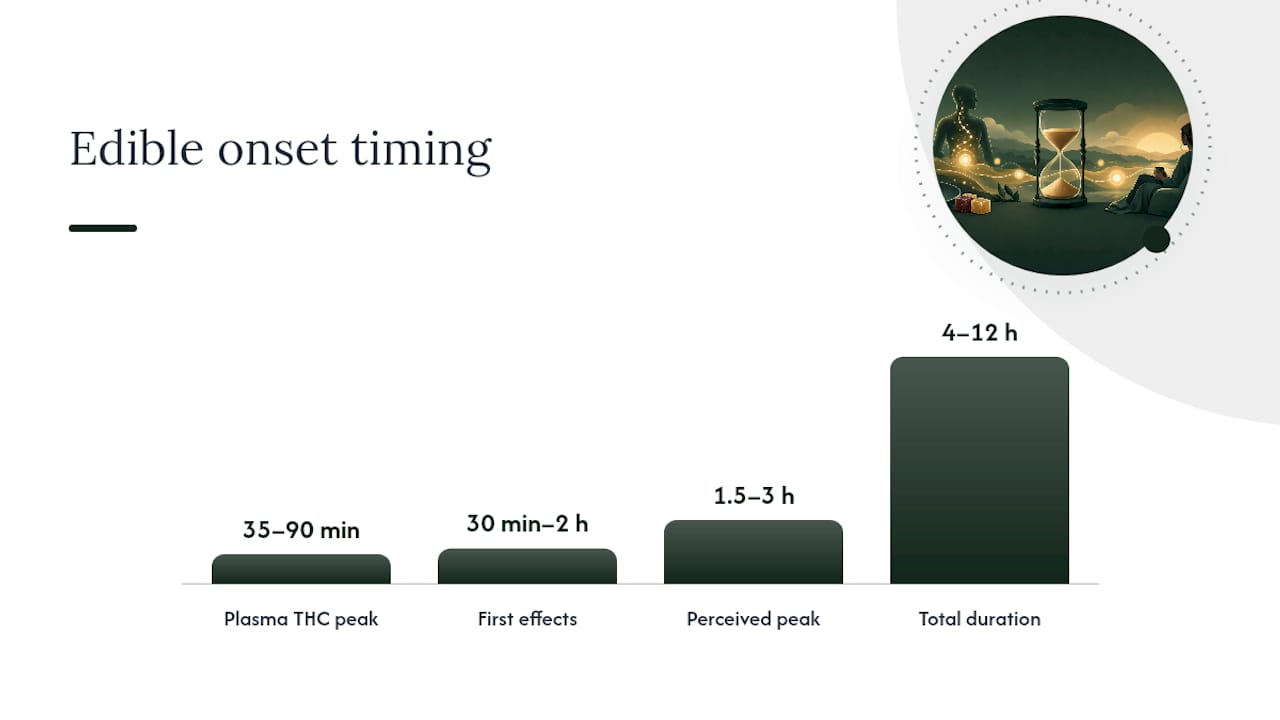
The numbers vary depending on which source you check, but they cluster in a predictable band. A pharmacokinetic study tracking plasma THC after oral ingestion found peak blood concentrations between 35 and 90 minutes, while people’s actual felt experience, the pharmacodynamic peak, showed up later, around 1.5 to 3 hours after eating a 10 to 50 mg dose. That gap between what shows up in blood work and what you actually feel is the single most misunderstood part of edible dosing.
Public-health guidance frames it a bit differently. British Columbia’s cannabis safety fact sheet tells consumers effects may not show up for up to 2 hours and can take up to 4 hours to fully peak. The Ontario Cannabis Store puts full effects at 30 minutes to 2 hours, peaking around the 4 hour mark. None of these numbers contradict each other. They’re describing the same biological process from different vantage points, lab measurement versus lived experience versus consumer-safety framing.
Here’s the planning-friendly summary:
- First effects: 30 minutes to 2 hours after eating
- Plasma THC peak (lab measure): 35 to 90 minutes
- Perceived peak (how you actually feel): 1.5 to 4 hours
- Total duration: 4 to 12 hours
The takeaway: if you feel nothing after 45 minutes, that’s normal, not a sign the product failed. The body hasn’t caught up to the lab chart yet.
Why Do Edibles Take Longer to Work Than Smoking?
Inhaled cannabis hits your bloodstream through the lungs in seconds to minutes. Edibles take a much longer route, and that route changes what actually happens to you chemically, not just when.
Swallowed THC travels first to your stomach, then your intestines, where it gets absorbed into blood heading straight to the liver. This is called first-pass metabolism, and it’s the reason edibles feel so different from a vape or a joint. Your liver converts a portion of the THC into a compound called 11-hydroxy-THC before it ever reaches your brain. This metabolite crosses the blood-brain barrier efficiently and appears to produce a more intense, sometimes described as more body-heavy or disorienting, psychoactive effect than THC alone. A pharmacology review comparing oral and inhaled cannabis points to this metabolic difference as a likely explanation for why edibles can feel stronger, pill for pill, than smoking the same amount of flower.
Inhaled THC skips this liver detour almost entirely, so smokers get less 11-hydroxy-THC and a faster, often more predictable ramp up and drop off. Edibles trade speed and predictability for a longer, sometimes heavier ride. That trade off is exactly why “start low, go slow” exists as guidance in the first place. You genuinely cannot rush your own liver.
What Factors Change How Fast Edibles Kick In?
Onset time isn’t fixed. It shifts based on what you took, how you took it, and what your body was doing beforehand.
- Dose and concentration. A higher milligram dose tends to intensify effects and, for some users, speeds up the point at which effects become noticeable.
- Product format. Gummies and baked goods route through full digestion and typically land in that 30 minute to 2 hour window. Sublingual tinctures absorb partly through tissue under the tongue, which can shave time off onset. Nanoemulsion beverages are engineered to break THC into microscopic droplets that absorb faster, sometimes within 10 to 30 minutes, though labeling and real-world performance vary by brand.
- Stomach contents. Eating on an empty stomach tends to speed up onset. A high-fat meal can delay absorption, and Health Canada’s guidance on cannabis use notes that fat can also change overall bioavailability in ways that aren’t fully predictable meal to meal.
- Individual biology. Metabolism, body composition, sex, and tolerance all shift the timeline. Someone with cannabis experience may notice effects sooner than a first-timer, partly from knowing what to look for.
- Medication interactions and product quality. Certain medications compete for the same liver enzymes that metabolize THC, which can alter both onset and intensity. Homemade edibles with uneven THC distribution are a wildcard for a different reason: you’re not just uncertain about timing, you’re uncertain about dose.
Pro Tip: Log what you ate in the two hours before your edible. Once you notice a pattern between meals and onset speed, you’ll be able to predict your own timeline far better than any general chart.
How Long Do Edible Effects Last?
Perceived peak typically lands somewhere between 1.5 and 4 hours after ingestion, and most people feel meaningfully “back to normal” somewhere in the 4 to 12 hour range. That’s a wide window, and it’s wide on purpose. Dose, product format, and individual metabolism all push it in different directions.
What catches people off guard is the tail end. British Columbia’s fact sheet notes that residual effects, grogginess, slower reaction time, mild cognitive fog, can persist up to 24 hours after a strong dose. That’s not the high itself continuing. It’s more like the tail of impairment fading out slower than most people expect.
The practical implication is simple: don’t schedule anything that requires sharp judgment on the same day you take an edible, especially a new product or a higher dose than usual. Driving, operating machinery, or making high-stakes decisions should wait until you’re confident the window has fully closed, not just until you “feel normal.” If you took an edible in the evening, treat the next morning with some caution too.
How Much Should You Take, and When Can You Redose?
The starter dose recommended across public-health guidance is 2.5 mg of THC or less for anyone new to edibles, according to British Columbia’s cannabis safety fact sheet. That’s often a quarter or less of a standard 10 mg gummy. It sounds small. It’s supposed to.
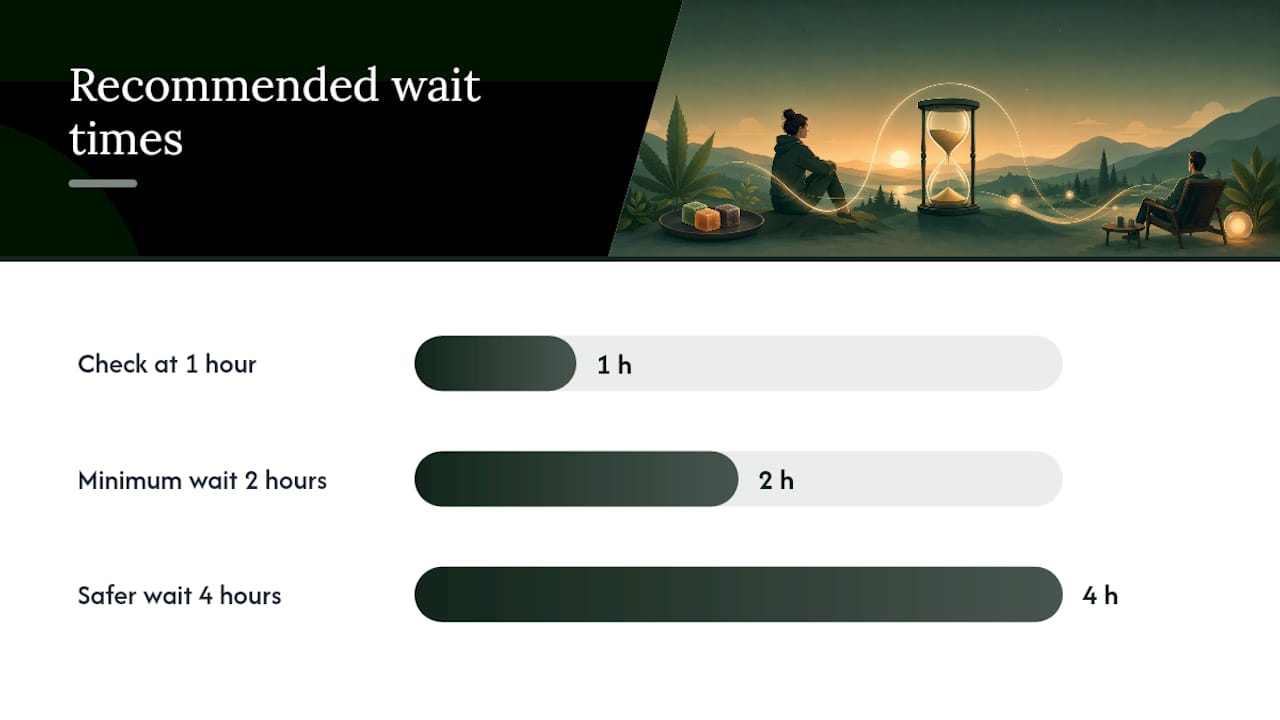
Medical experts at UCHealth point to premature redosing as the single most common mistake people make with edibles, and it’s an easy trap: 45 minutes pass, nothing seems to be happening, so a second dose goes in right on top of the first. Then both doses hit at once.
Here’s how to escalate safely:
- Take your starter dose (2.5 mg for beginners) and note the time.
- Wait a minimum of 2 hours before even considering more. Guidance from harm-reduction organizations like the Canadian Centre on Substance Use and Addiction suggests 4 hours is the safer bet, since perceived peak often keeps climbing through that window.
- Record the outcome: dose, wait time, how you felt at 1 hour, 2 hours, and 4 hours.
- Increase gradually on a future occasion, in small steps, only after you’ve mapped your own response curve.
- Never mix with alcohol, and check with a pharmacist or doctor if you’re on prescription medications that affect liver enzyme activity.
Pro Tip: Treat your first few edible experiences like a science experiment, not a night out. The data you collect on yourself is worth more than any dosing chart written for a general population.
How Can You Make Your Edible Experience More Predictable?
Consistency is the closest thing to a shortcut here. Keep the variables the same and the outcome gets easier to forecast.
- Eat a similar type of meal beforehand each time, rather than alternating between fasted and full-stomach sessions.
- Stick to regulated, lab-tested products with clearly printed milligram serving sizes rather than homemade treats you can’t accurately dose.
- Portion multi-serving edibles carefully. A 100 mg chocolate bar scored into 10 pieces is not evenly dosed unless the label says so.
- Keep a simple log: product, dose, meal, environment, and how you felt at each hour mark. Patterns show up fast once you’re tracking them.
Small, controlled experiments beat guesswork every time you try a new product or format.
When Should You Worry About an Edible’s Effects?
Most uncomfortable edible experiences are unpleasant, not dangerous. Anxiety, a racing heart, nausea, or a wave of paranoia are common and usually pass as the dose wears off. Lying down in a quiet, familiar space, sipping water, and reminding yourself the feeling is temporary handles most of these episodes.
Some symptoms cross the line into needing urgent care:
- Extreme confusion or inability to recognize surroundings
- Difficulty breathing
- Persistent vomiting that won’t stop
- Chest pain or a racing heart that doesn’t settle
- Thoughts of self-harm
If any of these show up, contact local emergency services or a poison control center right away. Bring the product packaging or label with you, or have a photo of it on your phone. Knowing the exact THC milligram count and product source helps responders act faster.
How Green On The Go Reduces Dosing Guesswork
A big part of edible unpredictability comes from not knowing what’s actually in the product. Some delivery services work exclusively with licensed, lab-tested brands to cut down on that uncertainty. Batch consistency means a 5 mg gummy today behaves like the 5 mg gummy you bought last month, which matters enormously when you’re trying to apply “start low, go slow” in practice.
Licensed cannabis delivery products often come with verifiable lab results, so the milligram count on the label matches the amount actually consumed. That’s the foundation any responsible dosing plan needs, before onset time or meal timing or tolerance ever enter the picture.
The Real Lesson Behind Edible Timing
Start low, go slow isn’t a slogan, it’s the only strategy that actually accounts for how unpredictable your own body’s absorption rate can be from one day to the next. Plan your day around the impairment window before you eat the edible, not after you’re already feeling it.
— Jake
Get Lab-Tested Edibles Delivered the Same Day
Guessing at potency is the biggest risk factor in edible dosing, and This delivery service removes guesswork by delivering only licensed, lab-tested products with lab results customers can check before ordering. Menu items from trusted brands often have verified milligram counts, so a “start low” dose can be a precise amount rather than an estimate.

If you’re in the East Bay, browsing by neighborhood makes it easy to find what’s available near you:
- Weed delivery in Berkeley
- Weed delivery in Dublin
- Weed delivery in Alameda
- Full coverage across Alameda County delivery areas
Check the lab results on the menu before you order, pick a starter dose that matches your experience level, and let a local driver bring it to your door the same day. Visit Green On The Go to see what’s currently in stock near you.
This article is general information, not a substitute for advice from a qualified doctor. Consult a qualified healthcare professional about your own circumstances before acting on anything here.
Sources
- Pharmacokinetics of oral cannabinoids (PMC8398280)
- Edible Cannabis Affects People Differently (BC gov fact sheet)
- Consuming cannabis: ingestion (OCS)
- Five things you should know about marijuana edibles (UCHealth)
FAQ
How Long Does It Take for Edibles to Kick In?
Most people feel the first effects within 30 minutes to 2 hours of eating an edible, according to British Columbia’s cannabis fact sheet. Onset speed depends heavily on whether you ate on an empty or full stomach.
When Do Edibles Peak?
Perceived peak effects usually happen between 1.5 and 4 hours after ingestion, even though plasma THC levels can peak much earlier, around 35 to 90 minutes. That gap between blood levels and felt effects is normal and expected.
How Long Do Edibles Last?
Most edible effects last 4 to 12 hours, with some residual grogginess or mental fog persisting up to 24 hours after a strong dose. Duration depends on the dose taken, your metabolism, and the specific product format.
How Long Should You Wait Before Taking More?
Wait at least 2 hours before considering a second dose, and 4 hours is safer since perceived effects often keep building through that window. Redosing too early is the most common reason edible experiences turn overwhelming.
What Is a Safe Starting Dose for Beginners?
Public-health guidance recommends starting with 2.5 mg of THC or less if you’re new to edibles. Greenonthegodelivery’s menu lists verified milligram counts on every lab-tested product, making it easier to measure out a starter-sized dose accurately.
Why Do Edibles Feel Stronger Than Smoking the Same Amount?
Edibles pass through your liver before reaching your bloodstream, a process called first-pass metabolism that converts some THC into 11-hydroxy-THC. This metabolite is linked to more intense subjective effects than inhaled THC typically produces.
Recommended
Ready to order?
Licensed, same-day cannabis delivery across Oakland, Berkeley, Fremont and all of Alameda County.
Order Online